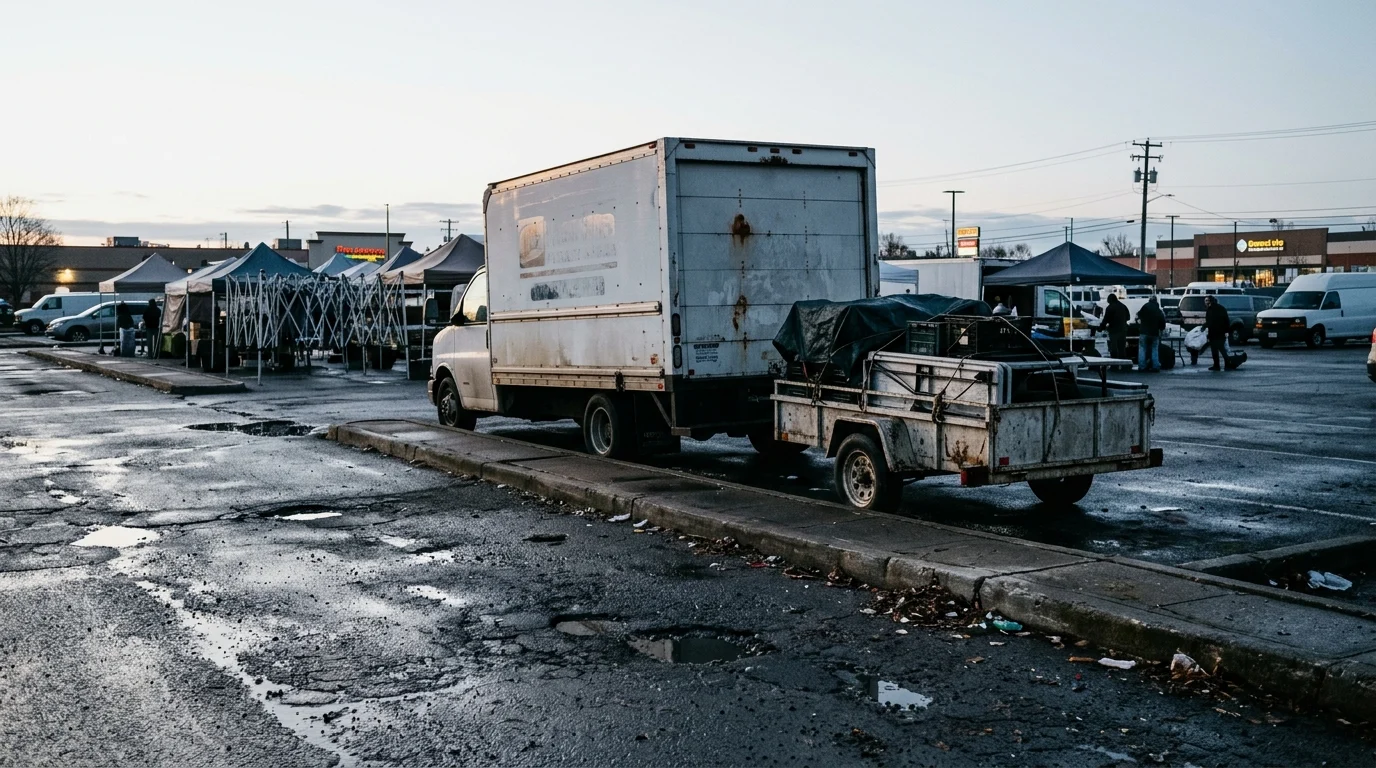
Setup at a city market: the truck, the curb, and the work that happens before the tents open.
The Infrastructure We Don't Count
Food reaches us through relationships, early payments and a lot of unpaid work. Our accounting leaves all three out.
Published October 26, 2026
This piece is a kind of trilogy. It brings together three conversations as one argument about food distribution: Rebecca MacLeod on the New Grocery Movement, Caylie Corvinelli on the Herd to Harvest Collective, and Laura Smit on farmers markets as civic infrastructure.
At Riley Park in Vancouver, the farmers' market sits on a plaza that was built for it. For ten years, farmers have been hopping the curb to unload, because the plaza went up before anyone checked the transportation ministry's loading rules. The trucks that make the market possible do not fit the place designed for it.
We had three conversations this month about that gap. Rebecca MacLeod of the New Grocery Movement described food insecurity as a policy choice: Canada grows enough food to feed everyone, and still 24 percent of people in the ten provinces, about 9.8 million, live in households that cannot reliably afford it. Caylie Corvinelli of Dalmeny Acres sells beef two years before it exists, because a first-generation farm cannot carry the cost of a cow alone. Laura Smit of Vancouver Farmers Markets argues that markets are civic infrastructure, not temporary retail.
None of them is asking for a miracle. Each is asking us to count work that already happens. The problem is not a lack of food, ideas or demand. It is that our accounting leaves out the work that makes the system run.
The door
MacLeod starts with a number and a cause. Income inequality, not how much food we grow, drives food insecurity in Canada. The barriers arrive before the price tag: whether there is a store nearby, whether the market is open when you are not working, whether you can get there at all. Convenience, she says, is often the only option rather than a preference. Community is genuinely inconvenient, which is why it has to be built on purpose.
She sees two ways forward. One is policy: basic income, a just transition for farmers, land access, public or non-profit grocery. The other is community organizing: gardens, kitchens, food hubs, and the literacy that comes from growing one tomato on a balcony. The New Grocery Movement is building food hubs in Edmonton and organizing people away from the commercial grocery aisle. A public grocery campaign is still working out what a Canadian version would look like.
What a grocery store counts is simple: what sells, what spoils, what each basket brings in. What it does not count is the labour that turns a store into a place where people can walk in and stay. The New Grocery Movement's team is volunteer. That is how the work gets paid for now.
The herd
Corvinelli farms 80 acres in Ontario with her husband, about 20 cows and 18 calves. Their farm store sells their beef, pork and eggs alongside turkey, chicken, milk, salt, hot sauce and sourdough from other local producers. It is a food hub in practice, whether or not anyone uses the phrase.
The collective is the clever part. Eaters buy a half or whole animal two years in advance and follow the herd until it becomes their beef. There have been three or four signups so far, at a price that limits who can join, and they have already changed the farm's year. "Farmers can't be the only ones with skin in the game," she says. The arrangement does something a loan cannot: it puts money in the farm's hands before the work is done, and it shares the risk with the people who will eat.
At the Sunday market, a customer once asked her for oxtail. Corvinelli did not have any. "Bring me some," the customer said, "and I will cook it for you." That is the relationship the collective is trying to make room for: not a sale, a standing invitation.
What the books show is a herd, a mortgage, and bills, including more than $300 for a bottle of meloxicam. What they do not show is the customer who paid two years early, which is a kind of farm finance. They do not show the veterinary training that saves a call, or the family hours behind the counter. Dalmeny Acres publishes the model. The books do not show what holds it up.
The curb
Smit has spent fifteen years with Vancouver Farmers Markets, which has been running markets in the city for thirty. The model depends on a simple exchange: the farmers feed the people, and the people pay the farmers. That sounds obvious until you notice how often the second half fails. Farmers stay with markets because markets pay them, sometimes when other buyers do not.
Thirty years in, the organization runs nine markets with 264 vendors, just under 60 of them farmers. About 80 percent of visitors walk or bike. Smit describes infrastructure as a range: pop-up tents and porta-potties at one end, permanent washrooms, truck access, shade, tree canopy and cold storage at the other. Riley Park was meant to be further along. Instead it became a lesson in what happens when nobody asks the market organizers where the trucks will park.
One piece of demand does get counted. British Columbia's Farmers' Market Nutrition Coupon Program, funded through the Ministry of Health, gives lower-income households up to $27 a week for 16 weeks and pays farmers in full. Health money becomes groceries for a family and income for a farmer in the same transaction. It is a small program with a large idea inside it: a food system can be financed from both ends at once.
What a city counts is a market day: a permit, a Saturday, a row of tents. What it does not count is thirty years of relationships, or the improvisation that fills in for missing washrooms and loading docks. It does not count the trust that lets a shopper keep buying carrots from a farmer whose politics they cannot stand. "Nobody says no to farmers markets," Smit says. That is why the argument is never about whether markets matter. It is about which department pays for the washroom.
The invisible subsidy
Put the three conversations together and the same thing keeps happening. The alternative food system is not waiting for a new government or a breakthrough. It is running now, on unpaid time, unpriced knowledge and patience.
Each example looks small on its own: a campaign for public grocery, a farm selling whole cows, a market asking for washrooms. Together they form a loop. Money reaches a household, and the household spends it with a farmer. The farmer has cash before the season starts. The market gives the farmer a place to sell, and the place turns a sale into a relationship that can repeat. Take one part away and the others stall. A coupon with nowhere to spend it is just paper. A herd with no customer is just debt. A beautiful plaza that half the neighbourhood cannot afford to use is just a plaza.
Work that never appears on the books holds the loop together. The volunteer team. The family labour and the veterinary skills. The fifteen years of solving problems on the fly so a city never has to build the loading dock. The eater who pays two years early. The relationships that hold a market together across political difference.
We do not count any of it, so we do not fund it, insure it, staff it or plan for it. The alternative looks cheap because someone else is paying.
There is also a question of time. Retail runs on the quarter. A beef animal runs on two years. Trust in a market runs on thirty. We plan on the shortest clock, then act surprised when the longer ones fail. Food insecurity, farm debt and markets that fold when one organizer retires are not signs that people are not working hard. They are signs that we are counting the wrong things.
The fix is not a new system. It is a second set of books, and some people have already started keeping it.
The next ledger
The future is already visible in small pieces. None of it needs a new technology. Each piece needs someone with authority to count the right thing and act on it.
A city can sign a multi-year agreement with a market instead of a yearly permit. It can put the washroom, the power outlets and the truck access into the capital plan, and bring the organizers in before the plaza is designed. Riley Park shows what happens when it doesn't.
A province can put money into households' hands and pay farmers in full. British Columbia's coupon program does both: health dollars become groceries and farm income in the same transaction.
A funder can pay the organizer, not just the project. The volunteer team and the family hours are why the alternative looks cheap. Paying them is the first honest cost.
A farm can sell a share of the herd two years before the beef exists, and a customer can pay early. Herd to Harvest shows that a few forward commitments can change a farm's year before the first calf arrives.
A farm store can sell its neighbours' food alongside its own. Dalmeny's store shows how a farm becomes a distribution point without waiting for a new building.
The New Grocery Movement can turn its Edmonton food hubs into a working model. It has the organizing experience and the community relationships. The next step is a hub with a door.
These are not isolated experiments. They are pieces of a distribution system that already works at small scale. The question is whether the people with authority will count them, fund them and sign the agreements that let them grow.
The first page of that ledger is not a strategy. It is a list of who does what, and when they get paid. The rest is a question of who signs first.
Related Episodes
Themes
- Food Distribution
- Food Security
- Local Food Systems
- Farm Economics
- Civic Infrastructure