The Truck and the Tent: Why Transportation Determine Whether Farmers' Markets Survive
We celebrate the tent and ignore the truck — and that blind spot is quietly deciding which markets live and which don't.
Published October 26, 2026
The Truck and the Tent: Why Transportation Determines Whether Farmers' Markets Survive
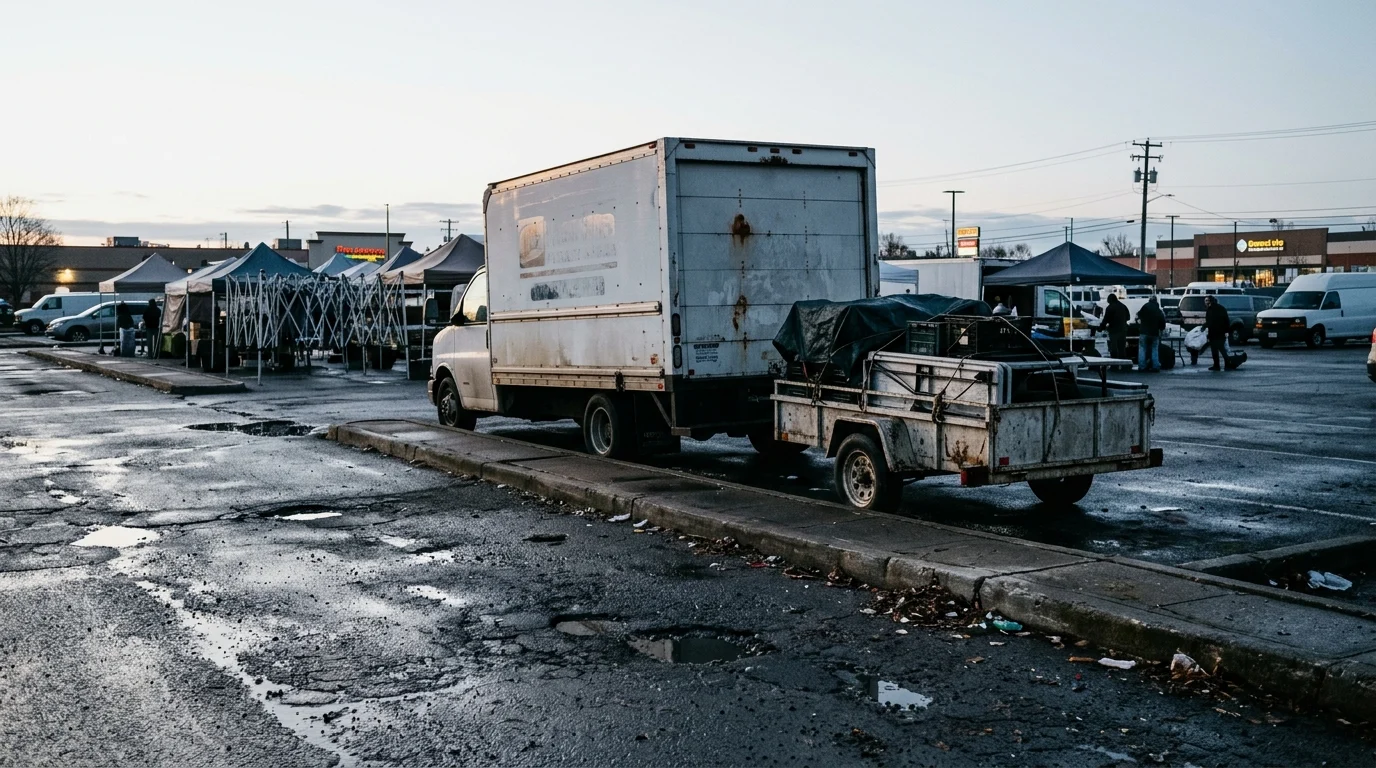
Every farmers' market photograph looks the same in one respect: the tent. The striped canopy, the pyramids of tomatoes, the hand-lettered chalkboard, the shopper holding a tote. What the image never contains is the thing that made the market possible in the first place — the truck, the trailer, the overheight vehicle, the loading sequence, the curb, the pothole, the parking meter. We photograph the tent and ignore the truck, and that asymmetry is not merely an aesthetic oversight. It is a policy failure with real consequences for whether a market can function at all.
Laura Smit, who has worked in farmers' markets for fifteen years and manages Vancouver Farmers Markets, describes the Trout Lake market in terms that resist the postcard: farmers "trundling down in their trucks and trailers on this pothole-ridden driveway," a site with "beautiful tree infrastructure" but no bathrooms, no plugs, generators running on the street. The tents are what the public sees. But the question of whether a truck can legally and physically reach the tent is what actually governs whether the tent can be there at all.
The Plaza That Everyone Designed Except the Market
The most concrete evidence in the conversation comes from Riley Park, the organization's year-round site, where a plaza was purpose-built for a farmers' market. The market had been written into a master plan, the park board was connected to it, and in theory a capital plan budget might even be found for it. And yet, as Smit puts it, when they set up the plaza, "someone didn't look at the transportation ministry." The site where the organizers thought vendors would load onto the plaza is not where they would legally be allowed to load onto the plaza. So for roughly a decade, farmers have been "hopping the curb onto a purpose-built plaza for a farmer's market because someone didn't bring the farmer's market organizers to the table."
This is worth pausing on because it inverts the usual story about markets and municipal neglect. The failure was not that no one cared. The failure was that care was expressed through planning processes that never accounted for the physical logistics of a truck. The market was designed in as a concept and designed out as a logistics problem. Smit's message to planners is blunt: "You want a farmers' market. It's not just tents on a plaza. You want actual vegetables. You gotta think about the trucks." Are those trucks going to park right behind the tents? That, she concedes, is "handy and useful" but "maybe not the image you thought you were going to get." If not, then the alternative has to be a place where an overheight or extra-long vehicle can actually park — and a route short enough that a farmer can unload and move the vehicle without making multiple trips.
Grassroots Is Not a Substitute for Infrastructure
Smit's framing of markets as "civic infrastructure" — economic, social, climate infrastructure, the language of the MakeSpace for Markets campaign — gains its force precisely because the physical, logistical layer has been absent. Vancouver Farmers Markets has been, in her words, "so good at grassroots" that it sometimes isn't actually building "the physical infrastructure or the physical spaces that actually support the people." Grassroots people, and farmers especially, are "some of the most adaptable problem-solving people I know" — but she wonders aloud whether they are "getting a little tired," or a little older, or whether the next generation is asking "really, you do what?"
That generational question is where transportation logistics and farm succession meet. A farmer contemplating a market career is already asked to accept small margins in exchange for soul and community. On top of that, she has to "jam myself into how small of a space" and "think about getting a sprinter van instead of a trailer because I gotta drive an urban street network." The sprinter van is a private adaptation to a public system's failure to accommodate. The market doesn't fail to exist because no one wants it — across the board, as Smit notes, "nobody says no to farmers markets." It fails to thrive because the state of the physical access rearranges which producers can realistically show up.
Who the Truck Serves — and Who It Doesn't
There is an equity dimension to the logistics that goes underappreciated. Smit estimates that roughly 80 percent of Vancouver market visitors arrive by walking, biking, or active transportation, a fact that "might blow some people's minds who we're not in City of Vancouver." The active-transportation reality — a genuinely good thing — limits how much groceries a shopper can carry, and that changes what farmers can sell. Then there's the parking question in reverse: if shoppers have to pay by the hour, some stop lingering, and Smit describes the trade-off precisely — "maybe I am just doing my in and out shop" rather than "sticking around having a coffee" or "taking my kids to play at the playground." A transportation pricing decision quietly reaches into the market's social function.
And the stakes compound for the farms themselves. Smit describes successful vendors as those working collectively — organic farms sharing a cooperative relationship, businesses changing hands within a cohort, heritage orchards linking with other growers. These collaborative structures depend on the market being a reliable, reachable destination week after week. When the truck's access is uncertain, the cooperative's whole operating rhythm is exposed. Transportation is the precondition for the relationship infrastructure that everyone celebrates.
The Tent Needs the Truck
The temptation is to conclude that more resources would solve this, but Smit resists the shiny future: the answer is a continuum. The pop-up tent with a generator and porta-potties is "a beautiful thing" and can go almost anywhere when a market is testing a site. But if it's been running for a couple years and has traction, a municipality should be asking whether it should shift into a place with a community centre and public-serving space, whether it should install shade, whether it should plant trees, whether it can add plugs so the generators come off the street. Whatever it adds, it has to think on "a longer cycle than just a special event cycle."
That is the directional conclusion. A farmers' market is regenerative because it is built to be temporary, but a temporary market should not be treated as a temporary project. It should be treated as infrastructure that happens to be assembled on Saturdays — which means the planning table at the start must include the truck as faithfully as it includes the tent. The vegetables come in the truck. The community comes for the tent. A city that plans for one without the other is planning for neither.
Related Episode
Themes
- Transportation as Hidden Market Infrastructure
- [object Object]
- Overheight Trucks and Parking Economics
- Farmers' Markets as Civic Infrastructure
- [object Object]