Renewable Diesel and Sustainable Aviation Fuel Are Opening New Frontiers for Canadian Canola
But the payoff depends less on agronomy than on regulatory certainty, freight economics, and roughly ten million tonnes of meal the sector still has to place somewhere.
Published November 27, 2026
The crop that became an energy input
For most of its history, canola has been understood as an export crop. Saskatchewan producers like Dean Roberts grow it, haul it, and largely watch it leave — for the United States, Japan, China, and for crushers in Asia who have long taken raw seed and processed it on the other side of the ocean. Roberts, a farmer and director with Saskatchewan Oilseeds, describes the crop in terms that are at once proud and plainly statistical: canola supports something in the neighbourhood of 192,000 jobs and roughly $44 billion in economic impact, it is grown by about 44,000 farmers, and it is the number one source of on-farm revenue for Western Canadian farms. It is, in his account, one of the few genuinely Canadian innovations in modern agriculture — bred from scratch by researchers such as Keith Downey and Bald Stinson, whose work on glucosinolates and erucic acid made the oil shelf-stable and palatable in the first place.
What is changing is not the crop but the destination. Over the past several years, a wave of crush capacity has been built in Western Canada, and Roberts puts domestic crushing at roughly 75 percent of any given production year. That figure matters more than it first appears. Once canola is crushed on the prairies rather than shipped whole, it splits into two marketable streams: an oil that can go into food, industrial uses, or fuel, and a meal that goes into animal feed. The build-out, as Roberts is careful to note, was not driven by food demand. It was "predicated around all of this new biofuel demand that we're seeing in the marketplace." Canola has quietly become an energy input, and the infrastructure is now being sized to feed that.
Why the fuel technology itself matters
It would be easy to treat "biofuel" as a single category and move on. Roberts draws a distinction that turns out to carry most of the practical weight. The older technology, biodiesel, worked but with friction — blend limits on some engines, and, critically for the prairies, cold-weather blending and flowability problems. His own farm truck carries a B20 sticker, meaning the manufacturer permits up to a twenty percent biodiesel blend; beyond that, older engines get complicated. Saskatchewan winters are unforgiving on fuel, and as Roberts puts it, anyone who has had a diesel truck gel up on the side of the road never wants to repeat the experience.
Renewable diesel is a different proposition. It is a drop-in replacement for hydrocarbon diesel, one-to-one, usable pure, and stable in the cold. That is a technical fit, not a marketing claim, and it is the reason the fuel has traction in a jurisdiction where temperatures are themselves a design constraint. The product can also be co-processed and blended at the plant. Then there is sustainable aviation fuel, which Roberts describes as just starting to take flight — for a sector where electrification faces a genuine physics problem, since aviation on batteries is a challenge that has no near-term answer. SAF is, in his telling, a whole new market, and one where Canada has as yet almost no domestic production capacity. The demand signal is visible; the processing infrastructure is not.
The scale of that demand is already reshaping the farm. Roughly one in three acres of canola now goes into biofuel use — a ratio Roberts notes is vastly different from just a few years ago — and it is adding about 62 cents a bushel to farm-gate prices. The Strathcona renewable diesel facility, if it sourced feedstock solely from canola, would by itself become one of the crop's top five markets. A single plant. On the demand side, the Clean Fuel Regulations are only now developing a domestic market that has historically been anchored in the United States, California, and the European Union. Canada is, in effect, late to a demand curve it helped create.
The constraints that no press release mentions
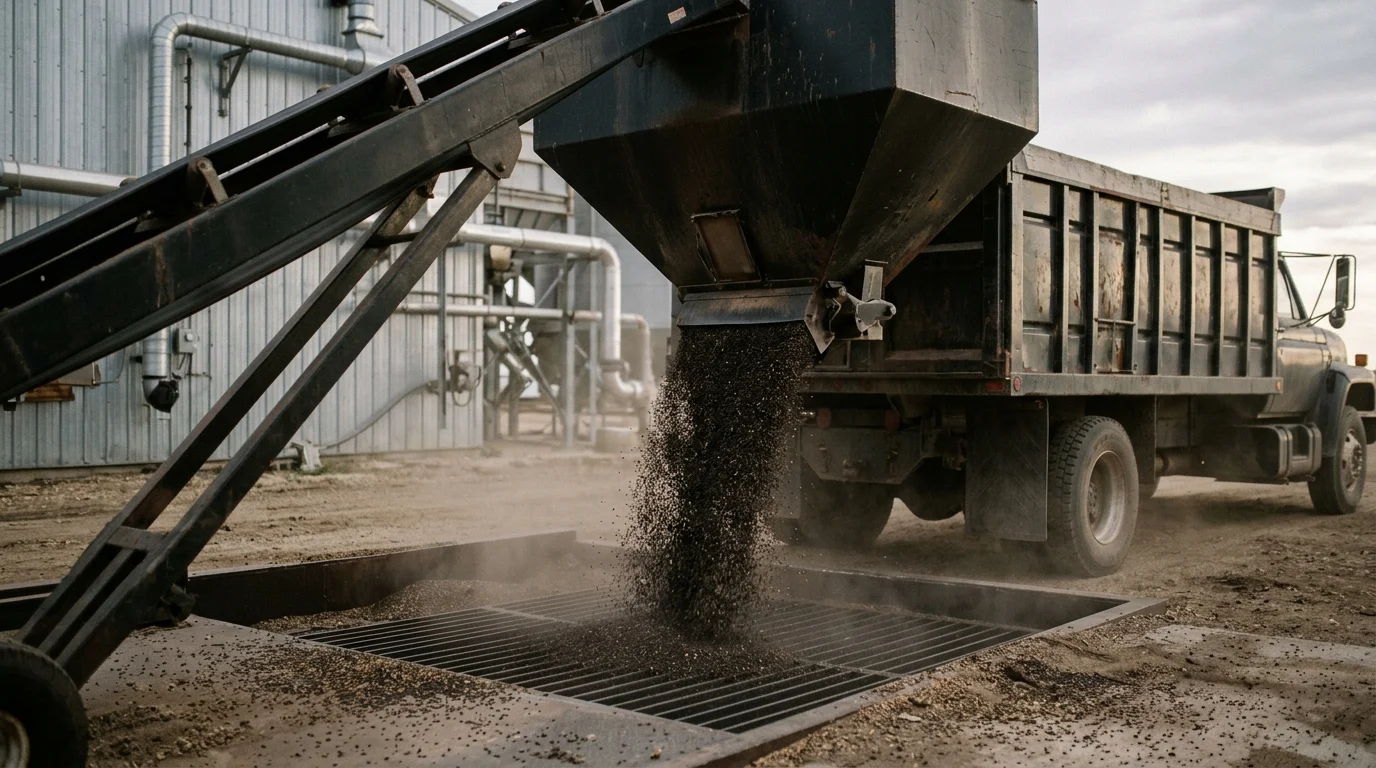
Roberts is a farmer first and, as he says, knows only enough to be dangerous on processing economics. But he is precise about where the model strains. Crush plants need draw areas large enough that they never run short of supply, and producers outside those zones see none of the freight advantage — his own crop splits between export and crush depending on the freight cost of the day. Rail access and the ability to move product to downstream processing matter as much as the plants themselves. And then there is the byproduct problem, which is the least discussed constraint in the whole expansion. A twenty million tonne crop crushed in full yields close to half oil and half meal: on the order of ten million tonnes of meal that must find a home. Historically, meal moved with the seed to Asia, where crushers were already sitting next to their feed markets. Shipping finished meal from the prairies is a different logistics proposition entirely.
Domestic outlets exist. A dairy cow on a canola ration produces an extra litre of milk a day, which connects the oilseed sector to livestock producers in a way export markets never did. Aquaculture in Southeast Asia, bioplastics, additional feed markets — Roberts names each of them and then names the caveat: the scale of the crop is simply enormous relative to what other domestic industries can absorb, and meal is only ever a portion of a ration blend. His conclusion is unsentimental. Canola has always been an export-oriented crop, and for the next number of years it largely remains one, even as domestic value-add grows around it.
Certainty, not technology, is the bottleneck
If there is a single answer to what could accelerate all of this, Roberts does not name a molecule or a yield gain. He names regulatory certainty. In a global market that has spent twenty-four months in upheaval, he argues, capital is withheld — "nobody wants to really take a gamble," because the risk is not merely commercial but policy-driven. What producers and investors want is clarity on market access, on trade, on what the rules will be in five years. It is a systems observation, and unsurprisingly so: Roberts came to farming by way of engineering, and he treats the farm as economic, environmental, and regulatory systems running at once.
His blue-sky policy list reinforces the same logic. Trade agreements to open markets. Trade-enabling infrastructure — rail and port capacity, given that some eighty percent of canola moves through the West Coast, because "there's no point in having a market if you can't reliably supply it." A research framework that keeps the crop from becoming a stationary target. And business risk management underneath it all, so that producers can afford to take the next leap without jeopardizing the farm. His point is that none of these works alone; they interlock.
What the frontier actually requires
The framing of food versus fuel, which dominated this debate a decade ago, has largely faded — and Roberts is right that the crop can serve both markets. What replaces it is a harder, more concrete question about placement: where the crush plants sit, where the meal goes, whether the fuel policy survives an election cycle, whether a farmer outside a draw area participates in any of this at all. Renewable diesel and sustainable aviation fuel genuinely open new territory for a Canadian crop that most Canadians cannot yet explain. But frontiers are not opened by demand alone. They are opened by freight, by regulatory durability, and by a sector's willingness to solve the unglamorous problems — a surplus of meal, a constrained port, a spring fertility budget — that arrive immediately after the good news.
Related Episode
Themes
- Biofuel Demand Reshaping Crush Economics
- Renewable Diesel as a Drop-In Replacement
- The Meal Byproduct Constraint
- Regulatory Certainty as the Binding Limit
- Export Dependence and Trade Infrastructure