Redefining Agri-Food by Integrating Surplus Management and Correcting Market Inefficiencies
By reframing edible surplus as a vital node in the supply chain rather than an inevitable cost of doing business, the agri-food sector can reconcile economic reality with systemic equity.
Published September 8, 2026
For decades, the conventional agri-food supply chain has treated waste not as an operational failure, but as an acceptable cost of doing business. Within large-scale retail and manufacturing, an accepted tolerance threshold—often hovering around five percent shrink—is baked directly into profit margins and cost-of-goods calculations. This structural acceptance defies basic economic and ecological logic. Edible food is systematically rerouted to landfills while communities grapple with rising food insecurity, generating a double burden of environmental degradation and unfulfilled human need. Yet framing this issue purely as a moral failing misses the structural reality: the modern food system is not suffering from a shortage of supply, but from a profound failure of connection, distribution, and market feedback.
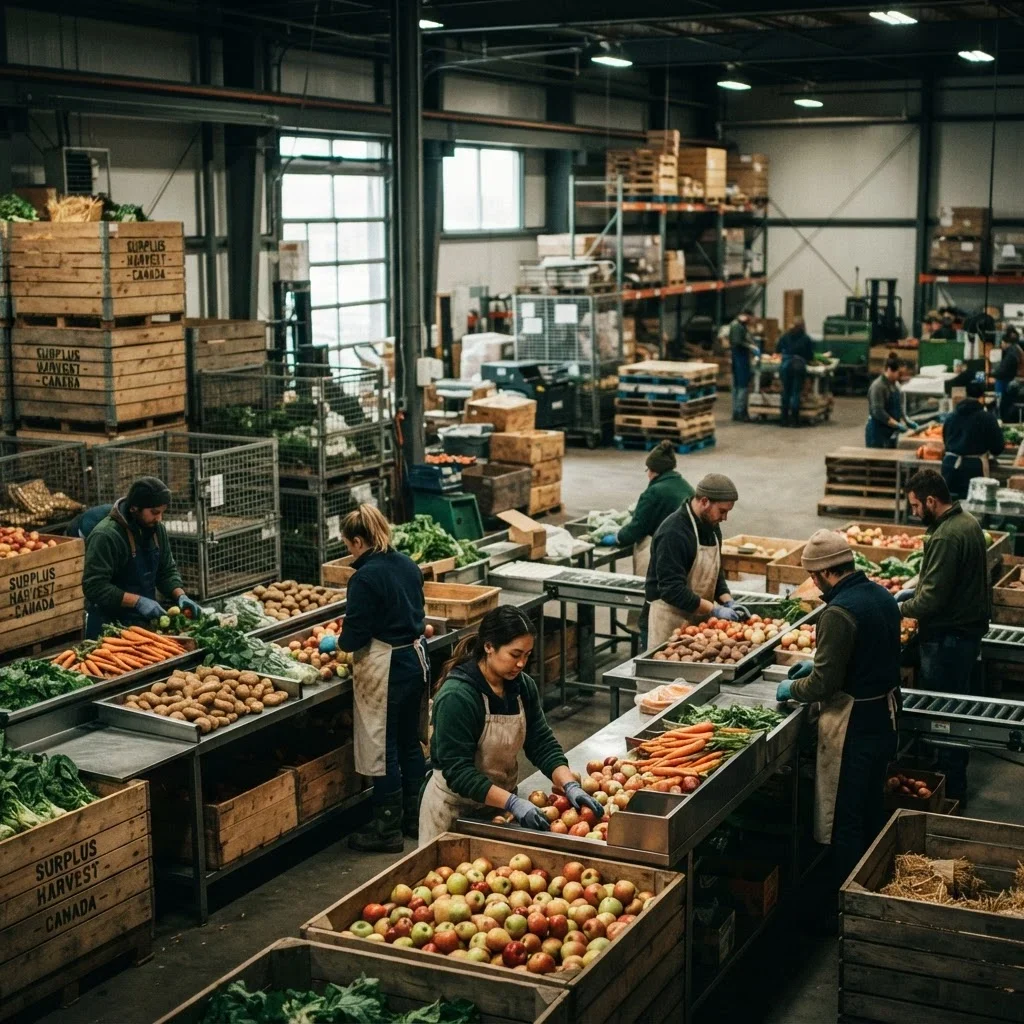
The emergence of digital surplus management platforms reveals how market inefficiencies can be systematically corrected when the invisible friction of trade is removed. For a major grower, packer, or retailer, the administrative burden of finding alternative outlets for off-spec or overproduced food is often too high to justify. When the default alternative is paying increasingly expensive municipal hauling and tipping fees, throwing food away can paradoxically appear operationally simpler, even if it is economically and environmentally irrational. By introducing digital match-making infrastructure that connects surplus generators with buyers, upcyclers, and emergency food providers in real time, these platforms transform waste into an asset class. This is where the broader definition of agri-food must expand: the sector encompasses not just the initial production and retail sale of food, but the entire lifecycle of management, redirection, and circular re-entry.
Crucially, correcting these market inefficiencies requires rethinking the economic models that support the social infrastructure of food rescue. Traditional charity-dependent models force food banks and rescue agencies to compete for unpredictable grants, leaving them chronically underfunded and operationally fragile. By embedding revenue-share mechanisms into surplus management—where organizations receive financial compensation for tracking and reliable collection—the sector professionalizes the invisible labor of community food security. When rescue agencies are properly valued and funded as essential service providers rather than passive receptacles for unwanted goods, they gain the capacity to train staff, meet food safety standards, and establish predictable operations. Aligning commercial savings on waste disposal with the economic empowerment of community organizations creates a self-reinforcing loop that traditional linear supply chains cannot replicate.
This transition from a linear take-make-waste model to a circular economy also exposes the limitations of relying solely on voluntary corporate goodwill. While sustainability officers in large enterprises increasingly champion waste reduction, small and medium-sized enterprises often lack the internal resources to navigate complex diversion pathways without operational disruption. Effective intervention demands a harmonized policy environment that employs both carrots and sticks—such as structured fees for landfill-bound organic matter paired with economic incentives for circular practices. Furthermore, the high-fidelity data collected through routine surplus tracking offers municipalities and policymakers an unprecedented lens into systemic bottlenecks. Rather than relying on sporadic annual audits, aggregated diversion data highlights where manufactured surplus is being systematically designed into agricultural production, pointing toward deeper structural reforms.
Ultimately, redefining agri-food through the lens of surplus management is an exercise in system design. As organizations like Food Mesh demonstrate, bridging the gap between waste and utility requires treating food not as an isolated commodity, but as a dynamic component of a resilient, diverse network. When markets are redesigned to reward circularity and value the human infrastructure at the receiving end of the supply chain, the food system moves closer to a state where surplus functions as a bridge rather than a burden.
Related Episode
Themes
- Surplus Management Infrastructure
- Market Toleration of Food Waste
- Economic Valuation of Social Agencies
- Data-Driven Regulatory Policy