41: The Logistics of Turning Food Waste Into Economic Value
Episode 41 · September 8, 2026
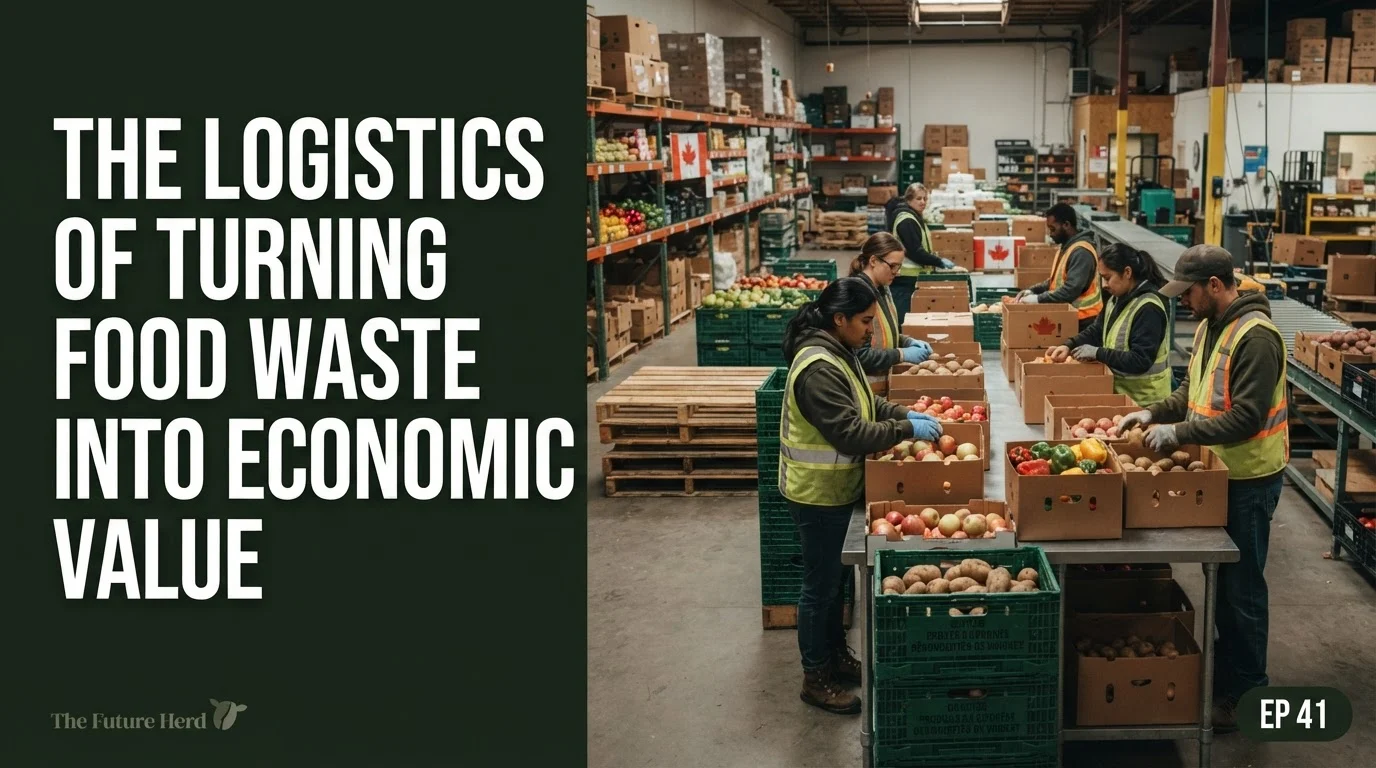
In this episode, Jessica Regan joins the show to explain how FoodMesh tackles Canada's agri-food waste crisis not as a shortage issue, but as a complex logistical and distribution challenge. By building digital infrastructure that connects commercial surplus food to safe alternative outlets—from human donation to animal feed—Regan demonstrates how turning waste into value requires aligning economic ROI with operational viability. The conversation explores everything from municipal zero-waste policies and backhaul transportation efficiencies to the evolving role of food banks in a circular economy.
Overview
Food waste in the modern agri-food system is an illogical inefficiency driven by a connection and distribution problem rather than a lack of food. In this episode, Jessica Regan joins the show to discuss how FoodMesh operates as a digital matchmaker and data-tracking platform, routing surplus food away from landfills and into safe, compliant alternative outlets within tight timeframes. The conversation unpacks the hidden social infrastructure of food rescue, examining how large supply-chain generators often overlook their waste due to snapshot audits and accepted shrink tolerances, while small and medium-sized enterprises struggle on tight margins without dedicated sustainability staff.
A central insight from the discussion is that sustainability initiatives must be anchored in economic reality to succeed. Regan argues that cost is king for businesses, meaning diversion strategies only scale when they directly reduce heavy waste disposal fees, tipping costs, and operational inefficiencies. To overcome these barriers, FoodMesh replaces unpredictable grant funding with a revenue-share and data-stipend model that provides partner food banks with stable, predictable income. This financial backing allows community organizations to hire professional staff, coordinate pickups, and handle perishable goods effectively, turning a chaotic charitable scramble into a streamlined logistical operation.
The conversation also tackles the complex web of municipal policies, regional disparities, and agricultural realities across Canada. Urban businesses and rural producers operate on vastly different stages of the waste diversion journey, leading to billions of dollars worth of nutritional biomass ending up in landfills while farmers face soaring feed costs. Regan highlights the enormous potential of utilizing logistical backhauls—empty return trucks and trains heading east from western supply routes—to move surplus food back where it is needed most. Moreover, high-fidelity data collection across tens of thousands of annual pickups reveals supply chain hotspots, exposing the absurdity of manufactured waste where producers overgrow crops simply to guarantee customer supply.
Ultimately, this episode challenges listeners to rethink food waste as a systemic design flaw that requires both regulatory carrots and sticks, such as circular waste taxes. Regan shares a visionary outlook where recovered and upcycled food transitions from an emergency measure driven by food insecurity to a mainstream, values-based consumer choice. For Canada's agri-food sector, embracing circularity offers a vital blueprint for building a resilient, collaborative, and economically viable food system from farm to fork.
Key themes
- Food Waste
- Circular Economy
- Supply Chain Logistics
- Agri-Food Innovation
- Food Security
- Sustainability Data