Ontario's Aquaculture Industry Is Feeding the World From Freshwater Farms Most Canadians Have Never Seen
While Atlantic salmon dominates the public imagination, a quieter inland industry — shaped as much by First Nations governance as by freshwater geography — reveals a different story about food-system resilience.
Published June 10, 2026 · Updated October 18, 2026
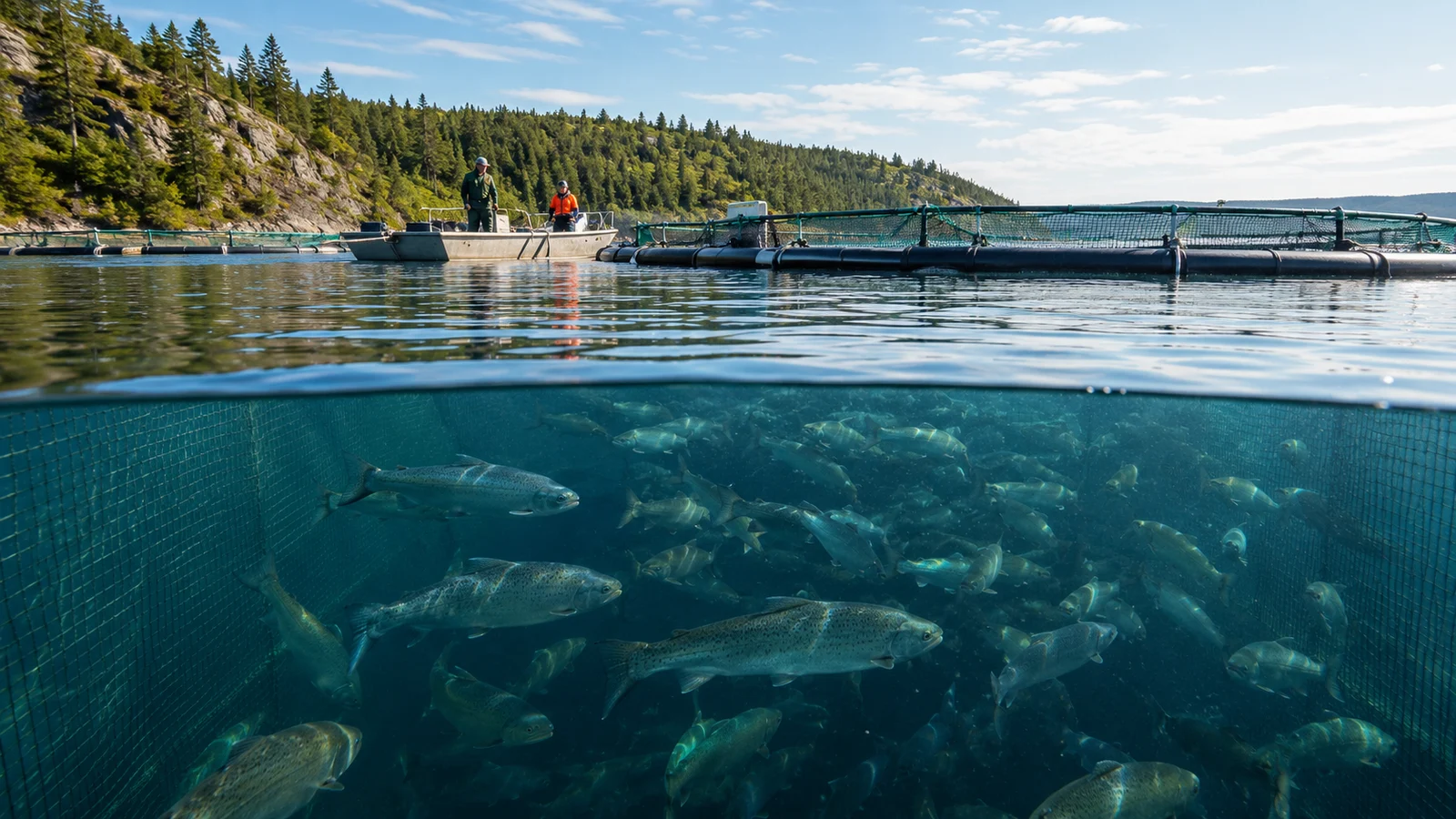
Fish farming in Ontario includes land-based hatcheries and freshwater net-pen operations in Georgian Bay and around Manitoulin Island. In Episode 29 of The Future Herd, second-generation fish farmer RJ Taylor explains how that inland industry depends on family-business adaptation, long production cycles, and First Nations partnerships. It is a different story from the ocean salmon farms that dominate public debate about Canadian aquaculture.
The wider shift is real, but the numbers need a clear definition. In its 2024 State of World Fisheries and Aquaculture release, FAO reported that aquaculture supplied 51 percent of global aquatic animal production in 2022, surpassing capture fisheries for the first time. That is a production measure, not the share of seafood Canadians consume, and it does not establish a forecast for the end of this decade.
Where Ontario's fish farms are — and why they are hard to see
Taylor, whose family operation has grown from a land-based hatchery to a multi-site business, names the industry's invisibility directly. The culture of aquaculture, he argues, is built on a kind of relentless ambient evangelism — fish farmers feel a responsibility to explain their work to whoever happens to be sitting next to them on a plane. That impulse exists precisely because the farms themselves are out of sight. Unlike crop farming or even poultry production, fish farming does not announce itself from the roadside. Net-pen sites are visible from the water; hatcheries are tucked into rural landscapes. The industry's geography is its greatest communications challenge.
But that geography is also, in important ways, a structural asset. Taylor describes a freshwater production system in which fish begin in land-based hatcheries before some move to net pens to grow to market size. Hatcheries and net pens are different parts of a production cycle, not interchangeable names for the same facility. The time from breeding and early growth to harvest can span several years. That timeline shapes capital requirements, exposure to market consolidation, and the strategic thinking a farm family needs to survive.
Diversification against buyer concentration
Taylor describes how his family's business learned this lesson the hard way. In the 2010s, following a fairly standard business-school logic, the operation concentrated almost entirely on rainbow trout fingerlings — juvenile fish sold to other farms. The focus made sense: fingerlings were a high-value product, and specialisation in breeding and early life-stage production seemed like a disciplined bet on core competency. What it created, however, was a dangerous concentration of customer dependency. As the net-pen sector consolidated, a diverse customer list narrowed toward a single dominant buyer. The logic of specialisation became the logic of vulnerability.
In Taylor's account, he and his sister Arlen responded by deliberately reversing course: expanding their species mix to include Arctic char, coho salmon, and lake whitefish alongside rainbow trout, building a home-delivery programme, maintaining a presence at farmers' markets and small retail, and supplying larger retailers through their net-pen partnership. During the interview, he described home delivery reaching roughly 1,500 to 1,700 Ontario households monthly. That is his account of the business at the time of the conversation, not a current audited customer count.
The business inhabits multiple market segments at once, a structure that looks inefficient on paper but functions as a hedge against consolidation. Taylor's lesson is not that every farm should copy the same product mix. It is that dependence on a narrowing group of buyers can turn operational efficiency into strategic fragility.
First Nations governance is part of the industry's foundation
Here the conversation moves into territory that reframes Ontario's aquaculture future. Taylor describes First Nations partnerships and community-authorized arrangements as central to the sector's development, particularly where provincial net-pen licensing has been difficult to obtain. His assessment of provincial delays is a practitioner's account, not a complete description of the law governing every site.
Waubetek Business Development Corporation's aquaculture FAQ offers important institutional context. It describes community jurisdictional rights, treaty rights and self-government, including agreements and band council resolutions. It identifies Giigoonh Chi-Naaknigewin (The Great Fish Law) as a more formal framework operating under a community's Chi-Naaknigewin. Community governance is not an absence of regulation, nor should distinct communities' arrangements be collapsed into a single generic permit route.
Waubetek also states that 75 percent of rainbow trout grown in Ontario net-pen operations are produced through long-term partnerships with Indigenous communities. That is its reported share of rainbow trout production, not a count of all fish farms. Taylor's interview separately offers an estimate about the geography of farms and partnerships; the two measures should not be treated as interchangeable.
The significance extends beyond licensing mechanics. Taylor argues that partnerships with First Nations, consultants and Waubetek can support current science and adaptive environmental monitoring. His claim is that the industry has grown, in significant part, through Indigenous governance — not merely despite regulatory obstacles. That is worth sitting with carefully in a national context where Indigenous participation is still too often framed as a future inclusion goal rather than existing jurisdiction, expertise and economic leadership.
What other food-system leaders can learn
What emerges from Taylor's account is a picture of an industry navigating problems that other sectors also face: buyer concentration, long investment horizons, relationships across supply-chain tiers, and governance partnerships that require more than consultation. None of that makes every aquaculture operation environmentally equivalent or settles the effects of a particular site. It does make the inland industry's experience relevant to a wider conversation about how food systems adapt.
The invisibility of Ontario's fish farms runs in both directions. Farms can be hidden from the public, while their governance relationships and hard-won business lessons remain equally hidden from agricultural leaders who might learn from them. Freshwater aquaculture is not just another source of protein. In this conversation, it is a way to ask who has the authority, relationships and flexibility to build a more resilient food system.
For the full account, listen to RJ Taylor on family-farm resilience and Ontario aquaculture.
Sources and context
- The Future Herd, Episode 29: Throwing Out the Business Textbook to Save the Family Farm — the conversation informing this article.
- Waubetek: aquaculture FAQs — institutional explanation of community governance, The Great Fish Law and its reported production-partnership share.
- FAO: global fisheries and aquaculture production, 2024 report release — the explicitly dated 2022 global production benchmark.
Related Episode
Themes
- Aquaculture's Invisibility as a Structural Problem
- First Nations Licensing as a Regulatory Lifeline
- Diversification as Resilience Strategy
- The Long Production Cycle and Its Business Implications
- Communication as an Industry Responsibility