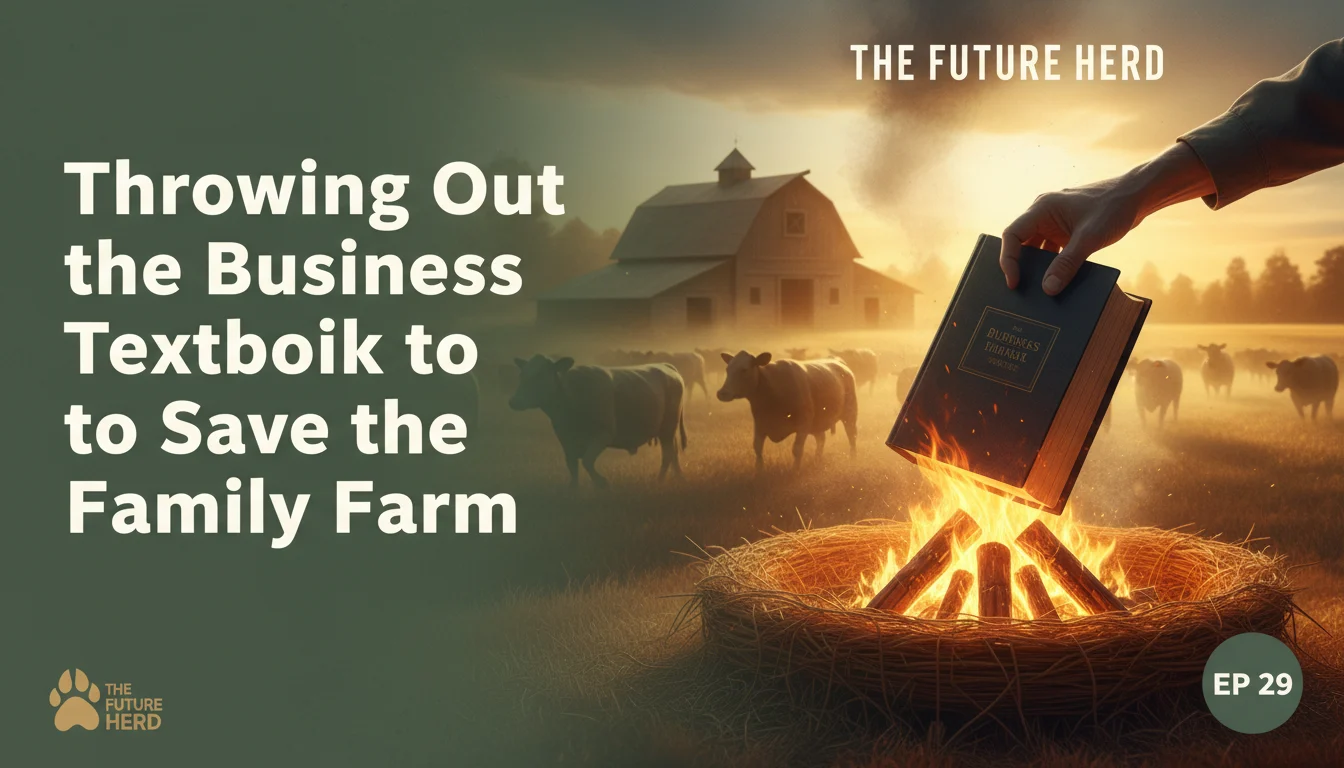
29: Throwing Out the Business Textbook to Save the Family Farm
Episode 29 · June 10, 2026
RJ Taylor, second-generation fish farmer and co-owner of a multi-site Ontario aquaculture operation, makes the case that the conventional business-school wisdom of focusing on core competencies nearly sank his family's business — and that deliberate diversification across species, markets, and sales channels is what actually builds resilience. In this episode, RJ walks Jesse through the geography and culture of Ontario aquaculture, explains why First Nations partnerships are central to Ontario's net-pen aquaculture sector, and argues that Indigenous partnerships aren't a policy aspiration but the structural backbone that has allowed the sector to grow when provincial licensing effectively stalled. Listeners will come away with a richer, more grounded picture of a food system hiding in plain sight on Georgian Bay and across Canada's coastlines.
Overview
RJ Taylor grew up hauling fish before school on his family's land-based trout farm in Ontario — and then, like his sister Arlen, left with every intention of never coming back. A sociology and business degree, a career in science communication, and a decade of distance later, both siblings returned with a much larger vision for what the farm could become. In this episode of The Future Herd, RJ joins Jesse Hirsh to make a counterintuitive argument: that the very business-school thinking he brought back with him — focus on core competencies, streamline, scale — nearly left the family operation dangerously exposed, and that the path forward required throwing that textbook out entirely.
The clearest illustration of that argument is what happened when Taylor Aquaculture narrowed its focus to rainbow trout fingerlings. The logic was sound: high-value product, clear market, strong margins. But as consolidation swept through Ontario's net-pen farms, a customer list of fifteen gradually compressed toward one, and the vulnerability became undeniable. RJ and Arlen responded by reversing course — adding Arctic char, coho salmon, and lake whitefish alongside the trout, layering in a home-delivery programme serving 1,500 to 1,700 Ontario households monthly, maintaining a presence at farmers' markets and independent retailers, and simultaneously supplying large-scale retail partners like Loblaws through their net-pen operation on Manitoulin Island. RJ is direct about the lesson: no single revenue stream could carry the business through the volatility the sector is experiencing, and it is the willingness to do everything at once that provides real resilience.
A second and equally important thread is the role of First Nations communities in Ontario aquaculture. RJ offers an estimate about farms operating through territorial partnerships and describes difficulties obtaining provincial net-pen licences. His argument is that community governance and partnerships are part of the sector's existing foundation, not merely an aspiration for future inclusion. For institutional context, Waubetek Business Development Corporation describes community jurisdiction, agreements and band council resolutions, and identifies Giigoonh Chi-Naaknigewin (The Great Fish Law). Its FAQ reports that 75% of rainbow trout grown in Ontario net-pen operations are produced through long-term Indigenous partnerships — a production share, not a count of farms. RJ argues that these relationships can support current science and adaptive environmental monitoring; his assessment of provincial practice remains a practitioner's perspective, not legal guidance for individual sites.
For listeners trying to understand Canada's food system, this episode fills in a significant blind spot: Ontario's fish farms can remain largely invisible even to the people who live closest to them. RJ's story — of a family business that survived by unlearning what it thought it knew, and of an industry shaped by Indigenous governance and economic partnerships — is the kind of grounded, specific conversation The Future Herd exists to amplify. The companion Knowledge article separates the interview's estimates from institutional sources and a dated FAO global production benchmark.
Key themes
- Aquaculture
- Business Diversification
- Family Farm Succession
- Indigenous Partnerships
- Ontario Food Systems
- Fish Farm Licensing