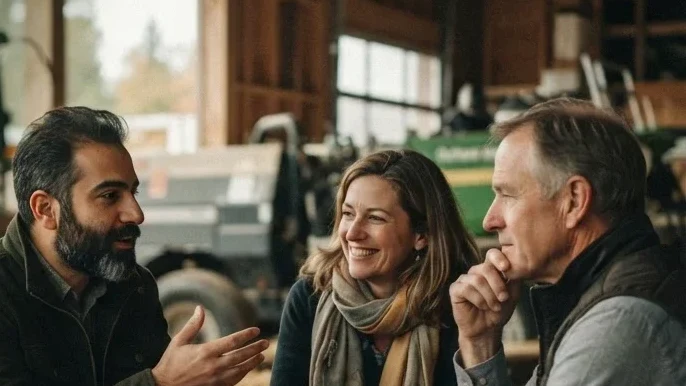
Adoption travels through people. Image from the herd's first year of conversations.
People Trust People
The worry about AI adoption in agriculture points at trust, then aims at the wrong target. Adoption is a literacy problem, and literacy runs on relationships.
Published October 27, 2026
This piece draws on five conversations from the herd's first year: Steph Towers on curiosity, trust and farm leadership, Todd Ormann on why innovation struggles to reach the farm, Mohsen Yoosefzadeh Najafabadi on the rise of the computational breeder, Mohamad Yaghi on technology as a democratic force, and the panel on farm data and edge computing where Donald Killorn laid out a farmer-governed AI platform.
There is a growing worry in Ottawa, and in the boardrooms of the agri-food sector, that Canadian farmers are not adopting artificial intelligence and data-driven practice quickly enough. The worry shows up in strategy papers, in funding programs, and in the patient tone of people who believe the future is obvious and cannot understand why the farm has not caught up.
When these leaders diagnose the cause, they usually land on trust, and they are right to. Trust is the obstacle. Then many of them make a fundamental mistake: they set out to build trust in the technology. Trusted systems. Responsible AI. Certified data governance. The machinery of reassurance, all pointed at the machine.
That is not how people work. People trust people. If a farmer cannot see or understand the people using and developing a system, trust never enters the equation, no matter how many certifications the system carries. And adoption is not really about solutions either, even though a tool that solves nothing deserves to fail. Adoption runs on literacy: the capacity to understand what a technology is, who is behind it, and what it is for. Literacy is what makes trust possible.
Over the past year, our conversations keep circling back to this. Nobody who works on adoption for a living describes farmers as slow. They describe a sector whose relational infrastructure has been dismantled, and they describe what actually moves a new technology onto a farm: a person.
The missing advisors
Mohamad Yaghi leads Ag Expert and the Innovation Hub at Farm Credit Canada, where he spends his days on the practical side of AI adoption. He is impatient with the story of the hesitant farmer. Farmers, he argues, "have always been on the cutting edge of adoption." What looks like reluctance is usually rational risk management. A startup arrives and asks a producer to "risk time on somebody that is already risky within an industry that is already contending with millions of risks." Declining that offer is not a mindset problem. It is arithmetic.
Todd Ormann of Olds College makes the structural version of the same point. Measured by acres rather than by farm count, he says, the vast majority of Canadian production already runs on precision technology. By his count, 80 to 90 percent of the large operations around him use it, against the 30 percent figure that circulates in conference decks. His number is an argument, not a census, and it comes with an acceptance of consolidation that not everyone in the sector shares. But it undercuts the premise that the farm is waiting to be convinced.
What has actually been dismantled, Ormann explains, is the pipeline that used to carry knowledge from research to the field. Public extension has thinned out. Applied colleges are funded to teach, not to research, so validation work survives on short projects stitched together from whoever will pay. The largest farms hired their own agronomists and brought extension in-house. Everyone else lost the person they used to ask.
Yaghi names the consequence plainly: the loss of the trusted advisor in the community leaves "a vacuum of trusted information," and "no matter what context it's in, whether it's through a person or through a tool, you don't have an appropriate replacement." A vacuum does not stay empty. Bad actors fill it. The adoption problem, in other words, is not that farmers distrust good technology. It is that we removed the people who made any technology legible, and then acted surprised when trust became scarce.
Where trust actually lives
Steph Towers has spent her career in farm leadership, and her account of where trust comes from has no machines in it. Social licence, she points out, is now earned online, through people: "this person that I see every day who looks like me and has a family like me." Her diagnosis of the expert class is the sharpest version we have heard. People did not stop believing experts, she says. "The experts stopped showing up in the places where trust is earned."
Towers is a practitioner telling stories from her own experience, not a pollster with a sample, and her evidence is anecdotal by her own admission. But the pattern she describes is the one Yaghi and Ormann describe from other angles: authority used to travel through institutions, and now it travels through visible, relatable people. Her conclusion for the sector is a sentence worth pinning to the wall of every AI strategy in the country. Agriculture is excellent at adopting innovation, she says, "but technology is never going to replace relationships."
Donald Killorn, executive director of the PEI Federation of Agriculture, has turned that sentence into an architecture. His members are nervous about who will own their data, and his answer is not to ask them to trust a platform. It is to give the data to an institution they already govern. Farm organizations, he argues, already have farmer-led governance: members elect the leadership. "All we have to do is add data to the thing that they're considering." He calls it the trust layer, and the phrase matters because of what it locates. The trust does not live in the encryption or the audit trail. It lives in the fact that the people holding the data are people farmers can see, question, and vote out.
Killorn is candid about how early this is. His platform's hardware was literally in transit when we spoke, and he names adoption as the sector's classic bottleneck even for a design built to solve it. But when we asked where confidence in such a system begins, he did not mention the technology at all. "It really starts with integrity," he said. "It starts with people being able to take you at your word. Everything flows from that."
Adoption is literacy
If trust attaches to people, then the practical question is how a farmer comes to see and understand the people inside a system: who built it, who governs it, who answers when it is wrong. That capacity has a name. It is literacy, and it is the part of the adoption conversation that almost never gets funded.
Mohsen Yoosefzadeh Najafabadi runs a dry bean breeding program at the University of Guelph and calls his field computational plant breeding. His lab built BeanGPT, a tool that lets a grower ask plain questions across hundreds of thousands of research publications. The design goal was not power. "The main point of developing BeanGPT is to make it accessible," he says, "for a variety of people with different backgrounds, with different knowledge." His first question to students who arrive excited about AI is not technical: why do you want to work with it? "Don't just follow because it's trend," he tells them. "Think before that."
His rule for farmers is the same. "If you can show the real benefit to them, that's perfect. If you couldn't prove it, what's the point?" The Ontario Bean Growers heard him out at their annual meeting and now advocate for AI in committees on his behalf. That is what adoption actually looks like: not a persuaded end user, but a literate one who has become an advocate. And his answer to the anxiety that AI will replace people is the best one-liner in our archive. It depends, he says, how many lines of code you are worth. "You are the one who is going to train AI. You are the one who is going to build AI."
Yaghi works the same vein from the product side. Define AI as "advanced statistical pattern recognition," he says, and it stops being magic and starts being a tool you can evaluate. His test for good design is that "whatever user uses technology, they don't feel like they're using technology." Both halves of that are literacy: plain language about what the thing is, and design humble enough to disappear into the work.
None of this stays at the research scale Mohsen works at, and none of it excuses the funding cuts he warns will not show their damage for a decade. The point is the direction. The people succeeding with AI in agriculture are the ones treating understanding as the deliverable, not the obstacle to it.
The fork
Put the conversations together and the choice in front of the sector comes into focus.
One path keeps treating innovation as something to be blindly adopted and trust as something to be placed in systems. That path is not new. It is the 20th century industrial mindset in fresh clothing: technology as something done to the farm, the farmer as an end user to be managed, and trust as a communications problem to be engineered away. On that path, Canada will keep writing strategies that wonder why the farm has not caught up, while the farms that matter make their own arrangements.
The other path is already visible in our own archive. It looks like a breeder chaining the eye he trained over years in the field to drones, genomics and machine learning: "We rely on our guts, on our feeling. Which is perfect. But at some point, we need to add more information." It looks like a sixth-generation farmer who is also a software engineer, building his neighbours' data infrastructure because he has been waiting his whole life for someone to build it. It looks like a federation that holds data because its members elected it to. Around the world, the systems gaining ground are the ones that combine AI capability with human intuition and human judgment. That combination is not a compromise. It is the product.
So the question for the sector's leaders is not how to make farmers trust AI. It is whether they are willing to invest, with the same seriousness they bring to the technology itself, in the people farmers already trust and in the literacy that lets a farmer look at any system and see the people inside it. Whose face is on the tool you are asking a farmer to use? Who do they call when it is wrong? If the honest answer is nobody, the adoption numbers will keep saying so.
Related Episodes
- Episode 8: Curiosity, Trust, and the Next Generation of Farm Leadership with Steph Towers
- Episode 11: Making Innovation Real: Bridging the Gap Between Research and the Farm
- Episode 18: The Rise of the Computational Breeder
- Episode 21: Technology as a Democratic Force in Agriculture
- 31: Dark Data and Edge Computing Are Reshaping Canadian Farm Strategy
Themes
- Artificial Intelligence
- Technology Adoption
- Trust
- Literacy
- Agricultural Innovation