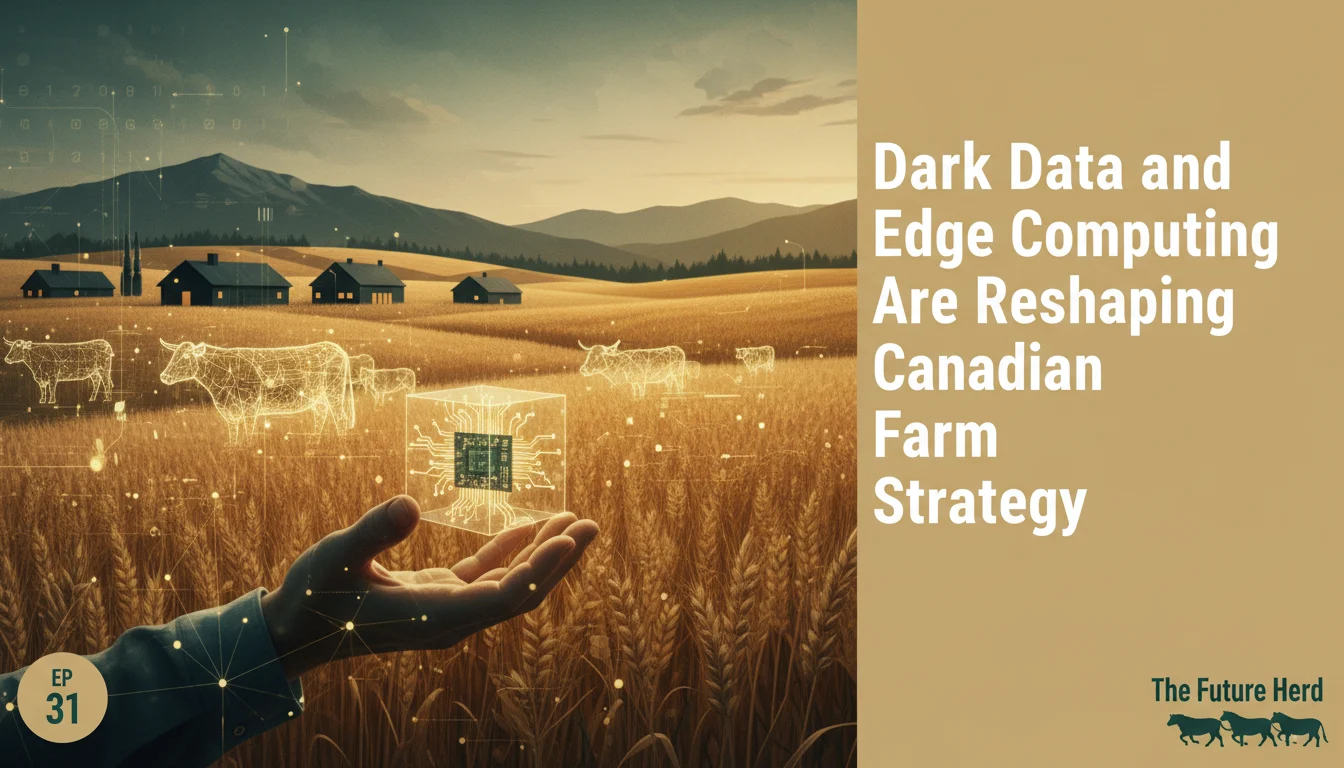
31: Dark Data and Edge Computing Are Reshaping Canadian Farm Strategy
Episode 31 · June 24, 2026
This episode brings together Canada's sharpest minds at the intersection of AI and agriculture to make a concrete case: the future of Canadian farm competitiveness will be decided not by whether producers adopt AI, but by how intelligently they manage, govern, and deploy the data they already have.
Overview
This episode of The Future Herd gathers Mohsen Yoosefzadeh Najafabadi, Mohamad Yaghi, Jennifer MacTavish, and Donald Killorn for a rigorous, advanced-level conversation about what it will actually take to make artificial intelligence work for Canadian farmers. The central argument is not that AI is coming to agriculture—it is already here—but that the decisions Canadian producers, researchers, and policymakers make right now about data governance, compute architecture, and model sovereignty will determine whether the productivity gains from AI accrue to Canadian farms or flow to the proprietary platforms of multinational equipment manufacturers and cloud providers. This episode is less a primer on AI and more a strategic briefing on the infrastructure choices that will define the next agricultural policy framework.
One of the most striking contributions comes from Mohsen Yoosefzadeh Najafabadi, who introduces the concept of 'dark data' to describe the enormous volume of agricultural research observations that are collected, archived, and never used again. Drawing on his own plant breeding programme—where he evaluates 200,000 individual plants but ultimately selects a handful—he points out that the discarded data represents precisely the kind of rich, domain-specific training material needed to build trustworthy, custom AI models for agriculture. His argument is that researchers and producers often do not mind sharing this kind of archival data, but lack the governance frameworks and institutional strategies to do so responsibly. His proposal: train models internally on pooled dark data, then share the model outputs rather than the raw datasets, preserving privacy while unlocking collective intelligence.
Donald Killorn grounds the conversation in the physical and political realities of deploying AI at farm scale, reporting directly from a week that included installing a rooftop WiFi gateway in eastern PEI and presenting to the House of Commons Standing Committee on Agriculture. His core insight is that the question of where computation happens—in the cloud versus at the field edge—is not merely a technical detail but a strategic decision with massive implications for energy consumption, data sovereignty, and farm autonomy. He estimates that moving every data point from Canadian farms to central models would require roughly 200 gigawatt hours of electricity, but that training edge inference models to process data locally and send only what is necessary upstream could reduce that figure to approximately 1.5 gigawatt hours. He also raises the unresolved tension with OEM equipment manufacturers like John Deere and Case, whose proprietary data platforms risk locking Canadian producers out of their own farm data, and describes the limits of industry-led interoperability initiatives like AEF's Agon connector.
Listeners will come away from this episode with a clearer understanding of why the ROI conversation around AI in agriculture has to move beyond productivity metrics and encompass labour shortage economics, energy infrastructure, data interoperability, and national policy. Mohamad Yaghi frames the stakes plainly: AI is most valuable not as an automation tool but as a decision-support layer that helps producers commit capital more wisely before it is spent. Taken together, the panel makes a compelling case that Canada's agri-food sector sits at a genuine inflection point—one where the choices made in the next two years around data governance and compute strategy will either entrench dependency on foreign platforms or establish a sovereign, resilient, and genuinely productive AI infrastructure for Canadian agriculture.
Key themes
- Dark Data
- Edge Computing
- Data Sovereignty
- AI Model Training
- Farm Decision Support
- Equipment Interoperability