34: Biomanufacturing Is the Next Agricultural Superpower Play
Episode 34 · July 15, 2026
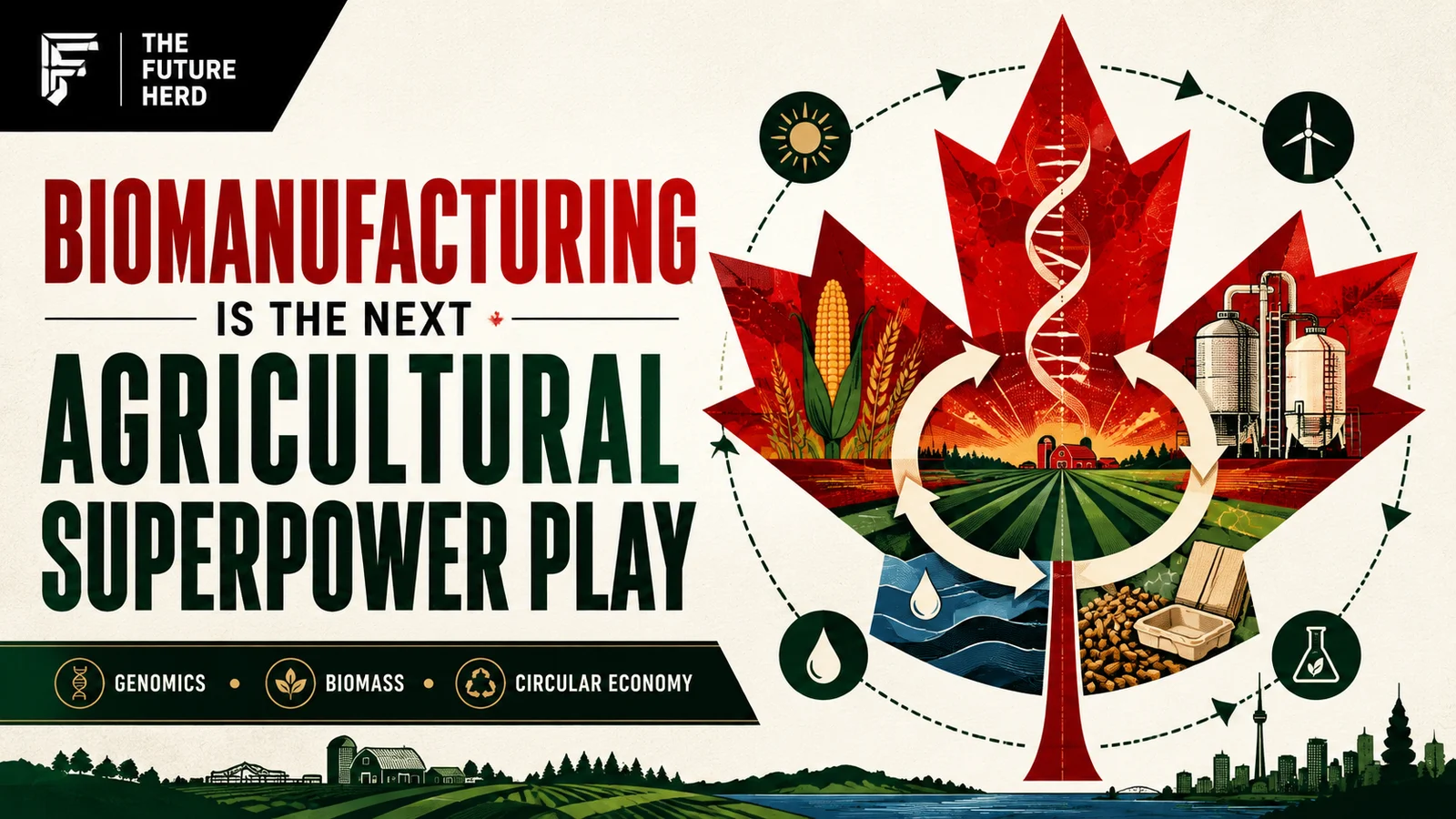
John Rafferty, CEO of Ontario Genomics, makes the case that Canada's combination of vast acreage, abundant water, and clean energy positions it to become not just an agricultural superpower but a biomanufacturing one — if it can close the capital gap in scaling infrastructure. Rafferty argues that genomics is moving from a specialised research field into the operating system of a circular economy, where biomass inputs from Canadian farms can replace petroleum-derived plastics, food colourants, and industrial chemicals. The episode is a call to action for policymakers, farmers, and investors to treat biomanufacturing not as a science project but as Canada's next major export industry.
Overview
John Rafferty arrived at Ontario Genomics fifteen months ago as a self-described outsider — a career that has moved through financial services, telecom, and the charitable sector — and he makes no apologies for that vantage point. In this episode, Rafferty unpacks the twin missions of Ontario Genomics: precision health on one side, and food and industrial biotech on the other. His central argument is that genomics has spent twenty-five years generating research and is now at a commercialisation inflection point, one where Canada's natural endowments — land, water, and clean energy — make it uniquely positioned to lead a global shift from extraction-based manufacturing toward circular biomanufacturing. He frames this not as a moonshot but as an obligation: roughly sixty percent of everything humans consume, he contends, can be bio-manufactured from agricultural biomass inputs and returned to the earth in a genuinely circular way.
Rafferty is direct about where the bottleneck lies. Ontario, despite hosting the majority of Canada's genomics innovators and post-secondary talent, lacks accessible biomanufacturing scale-up capacity at the thousand-litre range that startup companies need to prove their unit economics. Companies that want to produce hundreds of kilogrammes of a bio-manufactured sweetener or food colourant — enough to demonstrate price competitiveness against commodity sugar — are currently forced to travel to Nova Scotia, Saskatchewan, or another country entirely. Rafferty describes this as a capital problem, not a regulatory one, and he draws a deliberate analogy to the renewable energy transition: just as solar and wind power required patient investment before reaching cost parity with fossil fuels, bio-manufactured materials need that same scaling runway before they can displace petroleum-based plastics and chemicals on commercial terms.
A second tension runs through the conversation: the challenge of communicating a field where, as Rafferty puts it, there is a genome in everything. Ontario Genomics works across soil microbial health, cellular agriculture, rare-disease therapeutics, water bioremediation, and food ingredient innovation simultaneously — a breadth that risks dissolving into what he calls talking about world peace. His proposed solution is to pursue ground-level victories first: working directly with farmer groups to diversify revenue streams, demonstrating that Canadian-grown biomass can supply food ingredients currently imported at supply-chain risk, and letting those concrete wins build the narrative. He also raises the AI paradox squarely — acknowledging that artificial intelligence is accelerating genomic data analysis and commercialisation timelines while simultaneously carrying a significant and troubling environmental footprint of its own, a tension he says society has not yet honestly reckoned with.
For listeners in Canada's agri-food sector, this episode reframes a familiar question — how do we add value to what we grow? — at a much larger scale of ambition. Rafferty's vision is of Canadian farmers as feedstock partners in a national biomanufacturing industry that exports bio-plastics, proteins, and specialty ingredients the same way Canada has always exported grain and oilseeds, but with far greater value per acre. His policy ask is equally concrete: a national network of scaling facilities, challenge-based funding tied to specific import-substitution targets, and regulatory mandates with hard dates — the kind of policy signal that turned renewable electricity from an experiment into an industry. Whether Canada chooses to act on those assets or continues to send raw biomass across borders is, Rafferty argues, a question of political will, not scientific capability.
Key themes
- Biomanufacturing
- Circular Economy
- Genomics Commercialisation
- Scale-Up Infrastructure
- Agricultural Superpowers
- Soil Microbial Health