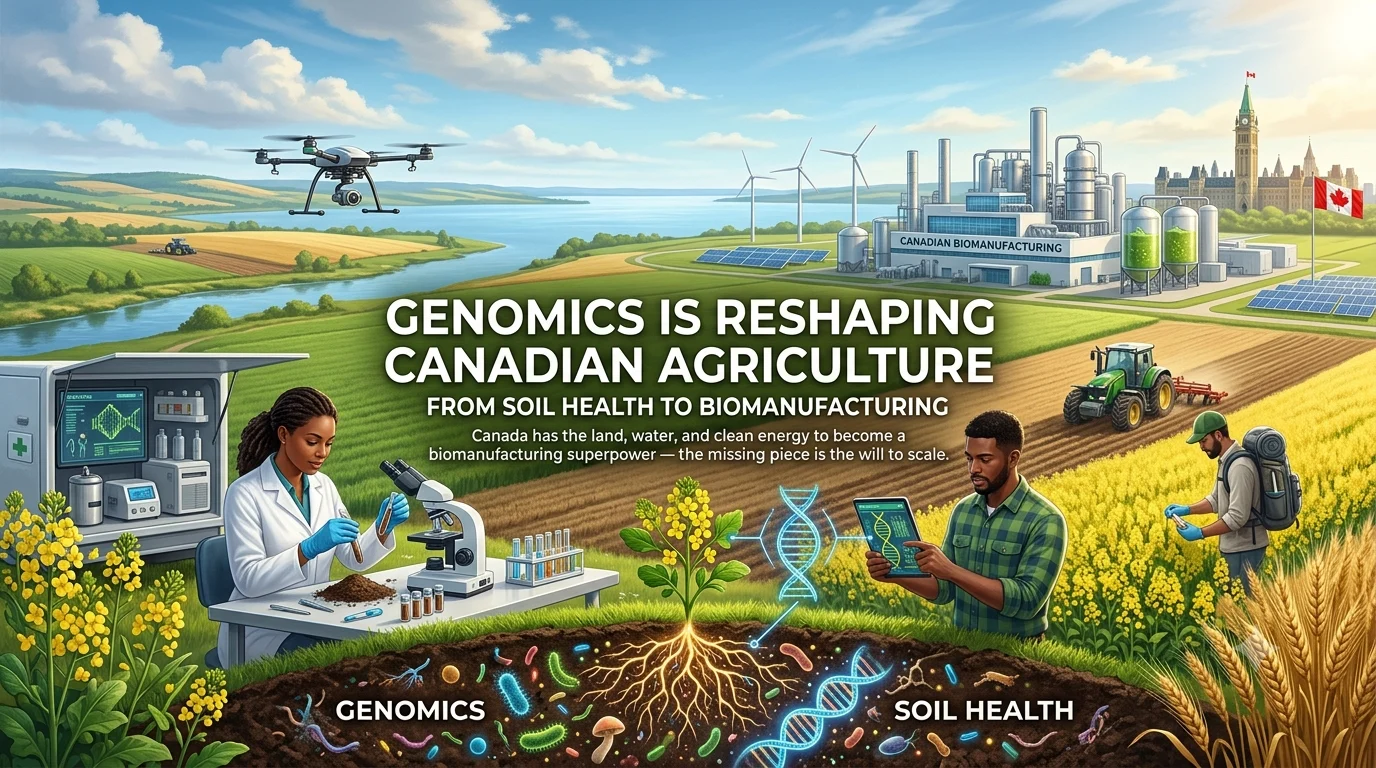
Genomics Is Reshaping Canadian Agriculture From Soil Health to Biomanufacturing
Canada has the land, water, and clean energy to become a biomanufacturing superpower — the missing piece is the will to scale.
Published July 15, 2026
For most of the past two decades, genomics in agriculture has been understood primarily as a tool for improving what already exists — hardier crops, more productive livestock, better-adapted seed varieties. That framing is not wrong, but it is increasingly incomplete. What John Rafferty, CEO of Ontario Genomics, describes in his conversation with The Future Herd is a second and more disruptive wave: the application of genomic science not just to optimize agricultural inputs, but to transform agricultural outputs into the building blocks of a post-petroleum industrial economy. The implications for Canadian farmers, policymakers, and investors are significant enough that the sector can no longer treat genomics as primarily a laboratory concern.
Agriculture as Feedstock, Not Just Food
The conceptual shift Rafferty is advancing begins with a claim that deserves to be taken seriously on its own terms: roughly 60 percent of everything humans consume can be biomanufactured, and if the origin is agricultural biomass, it can return to the earth in a circular way. This is not a futurist abstraction. The process Rafferty describes — using agricultural inputs like corn, lactose from dairy, or acid whey from cheese production as fermentation feedstocks — is already underway in pockets of the global economy. Yeasts are used to ferment these biomass sugars into outputs ranging from bioplastics and nylons to food colourants and proteins. The genomics layer is what makes the fermentation precise, scalable, and commercially viable in ways that earlier fermentation industries, including the ethanol sector that Canadian farmers are already familiar with, never quite achieved.
This reframing matters for how farmers think about value creation. The conversation on the show was explicit: biomanufacturing is not positioned as competition for agriculture, but as a complementary revenue stream that allows producers to extract more value per acre from crops they are already growing. A grain farmer supplying corn into a biomanufacturing fermentation process is not doing something categorically different from a grain farmer supplying into an ethanol plant — but the product range on the other end of the pipeline is vastly broader, and the margin potential in some categories, particularly specialty ingredients currently imported into Canada, is substantially higher.
The Soil Microbiome as an Underappreciated Frontier
Before biomanufacturing can scale, however, there is a more foundational genomic priority that Rafferty identifies, one that speaks directly to the day-to-day concerns of Canadian producers: the microbial health of soil. Every farmer intuitively understands that soil quality drives yield, and the practice of crop rotation exists precisely because generations of agricultural knowledge accumulated before the science that explains it. What genomics now offers is the ability to make that knowledge precise and actionable at the molecular level — to understand not just that rotating crops helps, but which specific microbial communities in the soil are being supported or depleted, how those communities respond to drought stress, frost events, or particular input regimes, and what interventions at the genomic level might protect them.
This is where genomic and microbial literacy converge. Rafferty draws an explicit parallel to the growing public awareness of gut health — a shift in popular understanding that has moved the concept of beneficial microbiomes from specialist biology into mainstream wellness discourse. The same transition is beginning in soil science, and it may ultimately prove more consequential. A farmer who understands the genomic profile of their soil is not merely working with better data; they are engaging with the fundamental biological infrastructure that determines long-term productivity. The research Ontario Genomics is funding in areas like frost and drought resistance in crops is downstream of this microbial understanding — and it is precisely the kind of work that speaks to the near-term risk management challenges farmers face as climate patterns shift.
The Scaling Gap That Is Holding Canada Back
The most structurally important problem Rafferty identifies is not scientific. It is logistical and financial, and it is specifically located in Ontario. Canadian startups working on biomanufacturing technologies — companies that have validated their products and are ready to begin demonstrating real unit economics — need access to fermentation capacity at the scale of roughly a thousand litres to produce the hundreds of kilograms required for commercial sampling and cost-parity analysis. That infrastructure does not meaningfully exist in Ontario. Companies are currently travelling to Nova Scotia, Saskatchewan, or other countries to access it. For a province that houses a significant proportion of Canada's genomics innovators and sits at the centre of the country's agri-food supply chain, this is a concrete and correctable failure.
Rafferty is careful to frame this primarily as a capital problem rather than a regulatory one. The regulatory environment around novel food ingredients does present challenges, particularly around speed of approval, but it is not the binding constraint. The binding constraint is that without the ability to scale production and generate real cost data, biomanufactured ingredients cannot be evaluated against their conventional equivalents on the criterion that ultimately governs industrial purchasing decisions: price per unit. Rafferty uses the example of a bio-manufactured sweetener competing against commodity sugar at roughly one Canadian dollar per kilogram. The science may be sound and the circular economy case may be compelling, but a food manufacturer will not switch inputs without a credible cost comparison — and that comparison cannot be made without scale.
The Policy Lever That Could Change the Timeline
The analogy Rafferty returns to repeatedly is renewable electricity. Solar and wind energy were, for decades, economically uncompetitive with fossil fuel generation. The transformation that made them viable was not purely technological — it was the combination of sustained public investment, regulatory mandates that created demand certainty, and the long-term cost reduction that follows from scale. He explicitly argues that biomanufacturing is at an analogous inflection point, and that policy mandates — for instance, requiring that a defined percentage of food packaging be made from bioplastics by a specific date, or phasing out synthetic food colourants in favour of biomanufactured alternatives — could play the same catalysing role that renewable energy standards played in the electricity sector.
This is a pointed argument, and it is worth sitting with. The biomanufacturing sector in Canada has the natural resource endowments — land, water, clean energy — to compete with any country in the world. The Netherlands and Singapore, Rafferty notes, have moved aggressively into precision agriculture and biomanufacturing precisely because their constrained land mass forces efficiency. Canada's vast agricultural footprint is an asset, but it has historically also reduced the urgency to extract more value from each acre. The risk is that the countries building biomanufacturing infrastructure now establish the cost curves and the industry standards that will define the sector for decades, while Canada continues exporting raw biomass and importing the finished inputs it could be producing domestically.
What Rafferty's analysis ultimately suggests is that genomics has moved past the stage where its agricultural applications can be understood as incremental improvements to existing practice. The convergence of genomic sequencing, AI-accelerated data analysis, and fermentation engineering is creating a genuinely new industrial category — one that is grounded in agriculture, oriented toward the circular economy, and capable of generating the kinds of manufacturing employment that provinces like Ontario are actively seeking. The science is largely ready. The capital infrastructure and the policy will are the variables that remain unresolved.
Related Episode
Themes
- From Extraction to Circular Manufacturing
- Agricultural Biomass as Industrial Input
- The Commercialisation Gap in Ontario
- Soil Microbiome as Genomic Frontier
- Biomanufacturing and the Case for Policy Mandates