Soil Health Is a National Asset That Canada's Food Security Strategy Barely Acknowledges
Canada plans meticulously for grain flows, port capacity, and grocery prices, while the depreciating capital that produces every one of those flows stays off the food security balance sheet entirely.
Published November 2, 2026
The Gap Between What We Secure and What Produces It
When Canada talks about food security, it talks about flow. It talks about rail service and port throughput, about the price of groceries in northern and remote communities, about the reliability of cross-border supply chains, about crop insurance payouts after a drought year. Each of these is a real problem, and each has a visible institution attached to it: a task force, a subsidy, a monitoring program, a line in a budget. The conversation is about moving food and making it affordable.
What the conversation is rarely about is the stock from which all of that flow originates. Soil gets mentioned, when it is mentioned at all, as an environmental file — associated with fertilizer emissions, carbon sequestration potential, wetland drainage, or stewardship messaging aimed at consumers. It is not treated as productive infrastructure whose condition determines whether the next decade of harvests is possible at all. That framing is not neutral. A strategy built to secure the movement of food while remaining silent about the depreciation of the land that grows it is securing a pipeline while ignoring the reservoir.
What Kind of Asset Is Soil
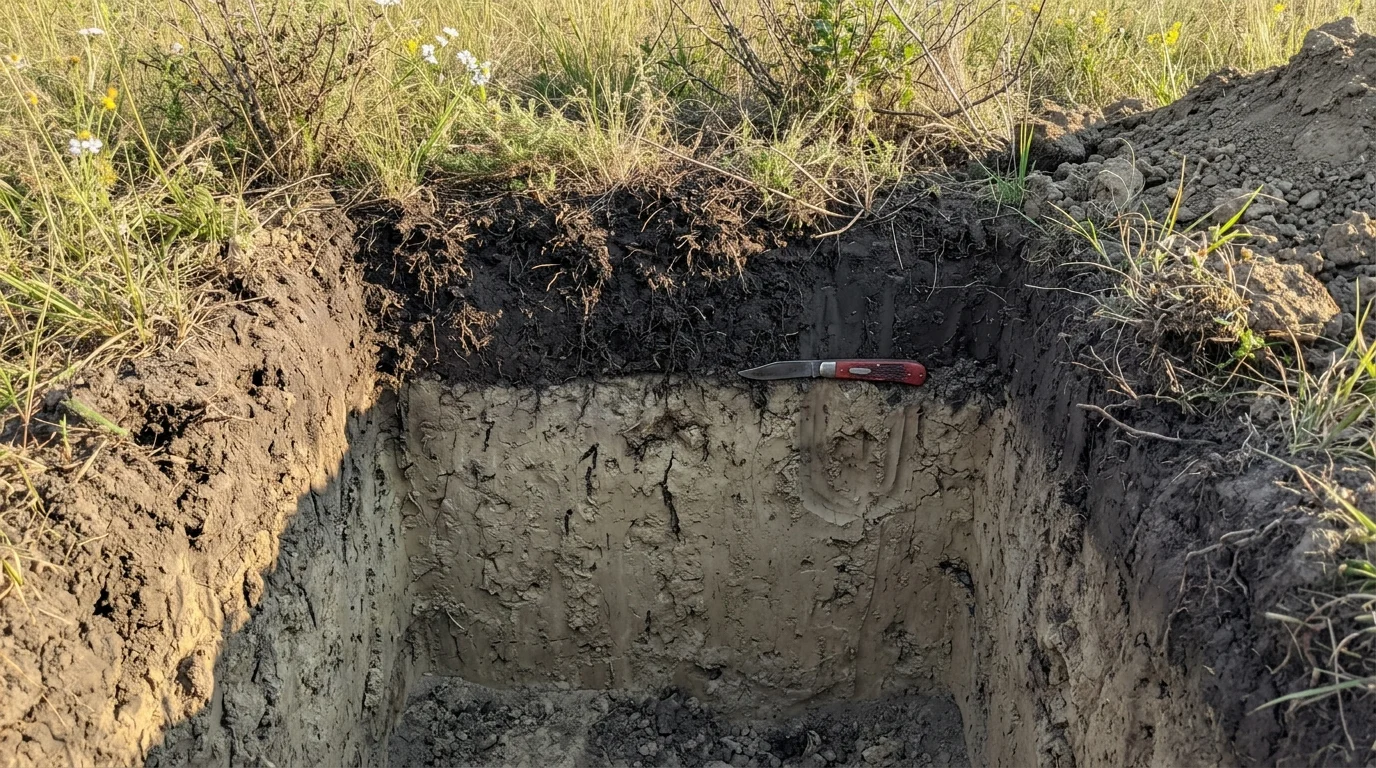
The word asset is not rhetorical here. An asset is a stock that generates a flow of value over time and that can be depleted faster than it is replaced. Soil meets every part of that definition. It stores and releases water, which is why a drought in a healthy field looks nothing like a drought in a degraded one. It cycles nutrients, which is why fertilizer efficiency and soil biology are not separate topics. It supports the biological communities that break residue and build structure. And in many Canadian systems it holds a meaningful amount of carbon, accumulated over centuries under grassland and forest.
The critical fact is the replacement rate. Topsoil forms slowly — on the order of a fraction of a millimetre a year in most conditions — while a single erosive storm, a decade of aggressive tillage, or a shift in rotation can move more soil than a human lifetime rebuilds. On any policy timescale, soil is not renewable. It is closer to a mineral reserve than to an annual crop, and it is managed as though it were the latter.
Yet Canada keeps no soil balance sheet. Statistics Canada records hectares, yields, and farm income with precision. Agricultural and agri-environmental indicators have tracked soil organic matter, erosion risk, and salinity for years — the measurement capacity largely exists. But those indicators live in an environmental reporting file. They do not feed the assumptions that food security planning rests on. When federal officials model grain availability, price shocks, or supply disruption, the productive base is treated as a constant: the land will be roughly as capable in ten years as it is today. That assumption is an unbooked liability.
Where the Incentives Actually Sit
If soil is an asset, the obvious question is who is responsible for maintaining it, and whether the people working the land are positioned to make investments that pay back over a decade. In much of Canadian agriculture, the answer is uncomfortable. A large and growing share of cropland is farmed under lease, often on short terms with cash rent arrangements. Building organic matter, changing rotation, or establishing perennial cover produces returns that compound slowly. A tenant on a three-year agreement who pays for a decade-long improvement is making a transfer to the landlord. The economics discourage exactly the investment the national interest requires.
Risk management compounds this. Business risk management programs and crop insurance in Canada are anchored to yield and revenue outcomes. They are indispensable, and they are also backward-looking: they compensate a loss after it happens rather than rewarding the buffer that would have prevented it. Water-holding capacity is a soil property, and it is one of the most valuable forms of drought resilience a farm can own. But a farmer who builds it receives no premium recognition, no improved coverage, no institutional credit. The program design treats the field as a black box with an output, and the output is what gets insured.
The counter-evidence is instructive. The widespread adoption of zero tillage across the Prairie grain belt was not driven by environmental regulation or public subsidy. It happened because direct seeding conserved moisture, cut fuel and labour, reduced erosion, and made yields more stable in a dry region. Producers changed a core practice within roughly a generation because the practice paid. That is the pattern worth noticing: where the economics line up with the biology, adoption is fast and durable. Where they do not, no amount of stewardship messaging moves the needle.
Making Soil Condition Legible to Food Security
None of this requires a federal soil ministry or a new layer of on-farm compliance. It requires that soil condition stop being an externality of food policy and start being a parameter of it. Three shifts would do most of the work. First, the indicators that already exist need to be read as production forecasts rather than environmental reports: soil organic matter trends in a region are leading indicators of that region's capacity to weather the next dry stretch, and should be weighed alongside stocks-to-use ratios and export projections. Second, support should move from paying for practices to paying for measured outcomes — the practice-based approach makes sense administratively, but it treats the activity as the goal when the goal is a change in the soil. Third, the tenure and insurance architecture should stop penalizing long-horizon investment, whether through lease terms that let improvements follow the improver, or through coverage structures that recognize a field's water and organic matter as risk-reducing infrastructure.
There is a fair objection here: soil management is local, agronomic, and specific to region, rotation, and soil type. National frameworks can flatten what needs to be precise, and farmers are rightly wary of measurement regimes that become regulation by another name. That objection argues for caution in instrument design. It does not argue for silence in strategy. The alternative to a measured national view is not local autonomy; it is that the productive base is assumed, unexamined, and quietly drawn down while planners optimize the logistics around it.
From Food Security to Land Security
The deeper reframe is a question of time horizon. Food security is usually discussed as a question of access and availability in the present — can people get enough affordable food now. But availability is a compounding function of land condition, and land condition is decided by thousands of small economic choices made under lease agreements, insurance rules, and market signals that currently say nothing about soil. A country that plans for the next quarter's supply chain while allowing the next generation's topsoil to depreciate has confused the schedule with the asset.
Treating soil as national capital would change the vocabulary. It would make "how much topsoil is left, and how well does it hold water" a food security question rather than an environmental one. It would make the farmer's balance sheet and the country's balance sheet converge. And it would recognize what the Prairie no-till experience already demonstrated: producers will build soil at scale when the incentives make it the rational choice, and not before. The strategy that secures Canadian food is the one that secures the ground it grows from.
Related Episode
Themes
- Soil as Depreciating National Capital Rather Than an Environmental Externality
- Food Security Framed as Supply Chain and Affordability
- Short Leases and Outcome-Based Insurance Displace Long-Horizon Soil Investment
- Prairie No-Till as Proof That Practice Follows Economics
- Measuring Soil Condition Without Feeding It Into Food Policy