Shared Commercial Kitchen Networks Are the Missing On-Ramp for Local Food Entrepreneurs
The barrier was never a lack of kitchens sitting empty after 5 p.m. — it was the absence of a trusted, documented way to hand a stranger the keys.
Published November 10, 2026
The Capacity That Sits Empty
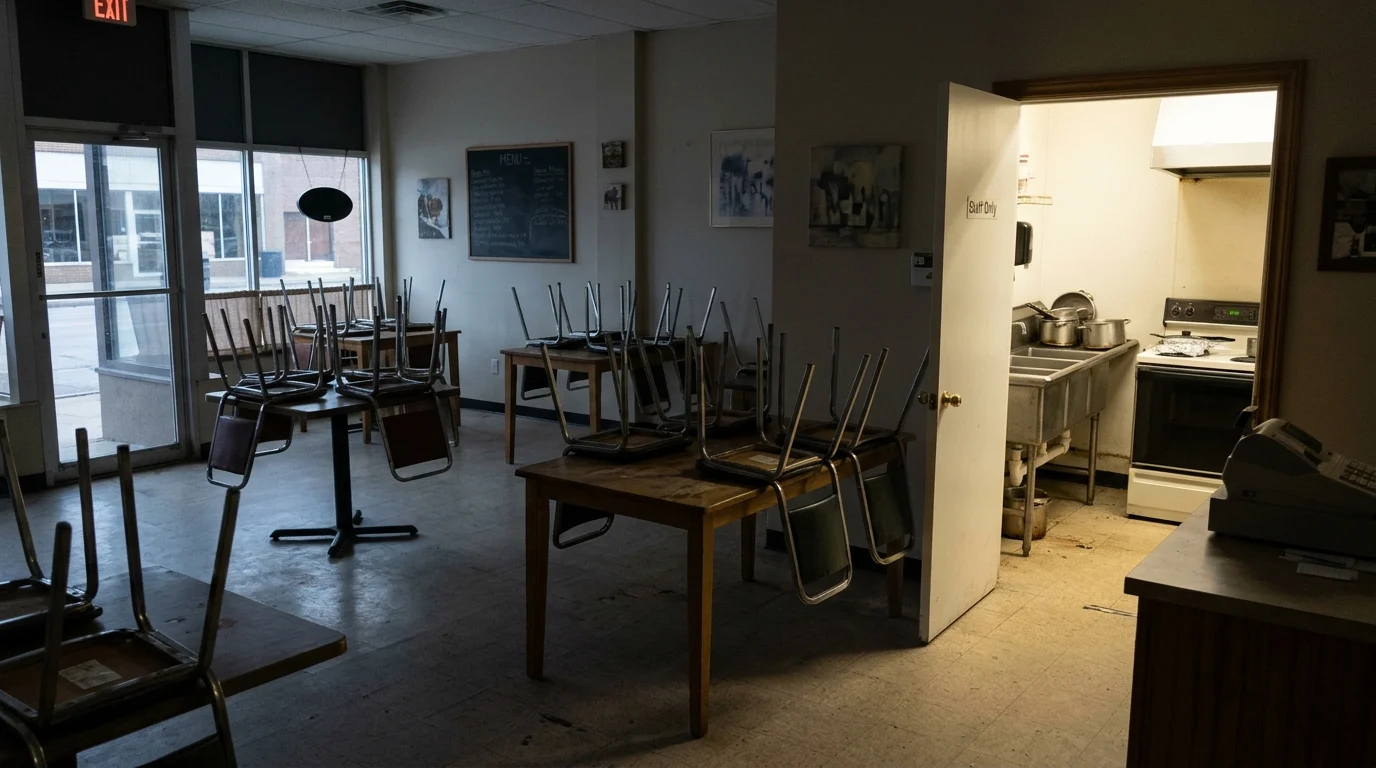
When Justin Andrews went looking for a kitchen in his early twenties, he did not go looking for a factory. He went door to door around his Nova Scotia community with a single request: can I rent your kitchen one day a week? He approached cafés that went dark at three o'clock. He approached churches and community centres with permitted kitchens and nobody in them after four. The answer, from dozens of conversations, was a mix of no and a hesitant "I don't know" — the hesitation usually attached to regulations, liability, and the plain strangeness of handing a near-stranger the run of a working kitchen.
He walked away from it. He went back to school for a degree in sustainability at Dalhousie University and, whenever he could, turned his research toward food. Working with Farmers Markets of Nova Scotia, a cooperative overseeing roughly forty-five markets, he ran surveys, focus groups, and interviews with food businesses and market managers across the province. Seven or eight years after his own failed door-to-door campaign, the same answer kept surfacing unprompted: access to kitchens. Not capital, not permits, not shelf space — kitchen access, the most mundane and most decisive constraint of all.
This is worth dwelling on, because the diagnosis contradicts the usual story about food entrepreneurship. The conventional framing treats small food producers as constrained by demand, or by consumer willingness to pay, or by the sheer romantic difficulty of the craft. Andrews' experience suggests something narrower and more fixable. The physical infrastructure to start a local food business already exists in almost every community, in churches, community centres, restaurants, and cafés, and it sits idle for a large fraction of every day. The failure is one of connection and confidence, not of capacity. A shared commercial kitchen network is, on this account, not a luxury for the sector. It is the on-ramp that determines who gets to enter it at all.
What "Commercial" Actually Means
Part of the problem is conceptual. The word "commercial" conjures stainless steel, gas lines, and industrial scale. Andrews is emphatic that this is wrong. A commercial kitchen, in the regulatory sense, is simply a kitchen that carries a permit from the local health inspector. A church kitchen that looks exactly like a home kitchen can be commercial. The permit turns on a defined list: a pest control plan, fire marshal sign-off on ventilation, and dishwashing capability, which means either a commercial dishwasher or a three-compartment sink for wash, rinse, and sanitize. Beyond that, the requirements follow the work. Deep frying or oil-spattering sauté requires commercial ventilation; baking does not. The inspector asks what is being produced and for whom, and sets conditions accordingly.
This matters commercially, not just pedagogically. In Nova Scotia, baked goods, pickles, and jams count as low-risk foods, and a producer can make them at home and sell them at a farmers' market. But the moment that producer wants to sell wholesale to a café that will resell the product, or wants to make anything protein-heavy or a pre-made meal, home production stops being legal. The step up is not a growth in ambition. It is a compliance threshold, and crossing it requires a facility the entrepreneur has no reason to own.
For someone still experimenting, a five-year commercial lease at a thousand or three thousand dollars a month is a nonsensical proposition. The actual need is one or two days a week, at hourly granularity, in a facility that is already permitted. The mismatch between how kitchens are held — as fixed assets of a single business, idle half the day — and how food businesses are started — in small, intermittent bursts of production — is the structural gap a shared network exists to close.
Trust Before Convenience
The hard part is not scheduling. It is trust. Andrews is candid that the response from kitchen holders has been "hit or miss," and that the objections are specific and reasonable. One café owns a forty-thousand-dollar oven with a touchscreen panel and sensors that can be fried by running it too hot for too long; its owner cannot reasonably expect a casual renter to study a forty-page manual. Insurance remains a recurring sticking point, even with providers willing to write coverage, because arranging it is a process nobody enjoys. And then there are the human failures that no platform fully prevents: renters arriving in flip-flops at a purpose-built shared kitchen in Ottawa, long-term renters quietly "borrowing" salt they had run out of.
The lesson Andrews draws is that a kitchen is not an Airbnb. There are far more touch points, far more ways to cause damage, and far more ways to compromise food safety. His first iteration of the platform optimized for the renter's convenience; the design had to be walked back. Today, an interested renter applies rather than books, describes the business, messages with the kitchen owner, and, if approved, attends a mandatory half-hour orientation before gaining calendar access. Bookings are first-come-first-served, payment is captured on-platform, entry is by code, and the record identifies who was in the room and when. Ratings run double-blind in both directions, and unlike a consumer travel account, a user cannot simply start over with a fresh email — identity and documentation are attached to the account.
"Easy, but not too easy" is the governing principle, and it is a more interesting design philosophy than it first appears. The aspiration Andrews names is normalization: making shared kitchen access as ordinary as a stranger renting the spare room became through Airbnb. But normalization in this domain cannot mean frictionless. It has to mean a well-documented, deliberately slow process that leaves the kitchen owner in control of their expensive equipment and their permit standing.
The On-Ramp Is a Ladder
The value of the network is clearest when the path it enables is traced past the first booking. Andrews is direct that the platform has not yet accumulated many growth stories — it went live only in December of the previous year, and most renters are still selling at farmers' markets. But the trajectory he describes is legible. A tea blender tested products at market, and now several small retail stores want to carry them. In New Brunswick, a protein cookie producer moved from market to small retail to major grocery listings. The next step after retail traction is evidence: sales history, revenue growth, demonstrated iteration on product.
And then relationships. Andrews' account of Atlantic Canada is that the shortcut to a listing at Sobeys or Loblaws is not an application form, where a producer will sit in a backlog, but a pitch in front of grocery buyers at Food and Beverage Atlantic, and, more importantly, a distributor already in place. A listing at a major chain is not one store; in Atlantic Canada it may mean two hundred, which no small producer can serve with their own fleet. The distributors who already supply those stores are the ones who make scale possible, and the seasoned advice is to build that relationship before approaching the retailer at all. Arriving with a product, evidence, and a distributor ready turns a plea into a conversation.
This is why Andrews frames the venture as more than a booking tool. Alongside the kitchen rentals sits an asset map — kitchens, markets, retail, distribution, suppliers — designed as a living, co-edited dataset that anyone can add to or correct. The point is to replace the losing battle of searching for "distributors in Nova Scotia" against paid search results and irrelevant listings with a filterable, regional directory of who actually exists. Not everybody can afford the conference ticket that puts them in the room with the right buyer. A shared index is the cheaper substitute for being well-connected.
The Network Underneath
The broader ambition is to become infrastructure rather than destination. Andrews points to the hotel sector, where a single inventory can appear on Hotels.com, Expedia, Booking.com, and the hotel's own site because a shared backend keeps availability synchronized. Today, a kitchen listing on two competing shared-kitchen platforms risks a double booking; there is no common layer. Building that layer is the stated direction, and the underlying system is exposed through an API and an MCP server so that other builders can compose it like Lego blocks. The example offered is a tractor-sharing app built on the same substrate, or a walk-in fridge rental for a farmer with a surplus of eggplant waiting on a distributor. A single operator may need a kitchen for salsa, cold storage for the harvest, and equipment for the rest — and all of it is an asset idling somewhere in the community.
What emerges is a modest but genuinely structural claim. Local food is often pictured as produce at a market stall — fruits and vegetables, maybe a butcher. But the diet is mostly shelf-stable and processed: crackers, canned soup, mayonnaise, hot sauce. Those categories are produced at massive scale and shipped in. For them to be made locally, the businesses that would make them must first exist, and they cannot exist without a permitted room, an hour at a time, at a price that does not assume a lease. The kitchens are already there. What has been missing is the connective tissue — the application, the orientation, the record, the insurance, the map, and above all the trust — that turns idle square footage into an on-ramp. Build that, and the local food economy stops being a story about produce and starts being a story about production.
Related Episode
Themes
- Idle Kitchen Capacity Versus Startup Capital
- Commercial Does Not Mean Industrial
- Trust Before Convenience In Shared Spaces
- The Evidence Ladder To Grocery Shelves
- Base-Layer Infrastructure Over Booking Platform