Reducing Farm Burnout Requires Smaller Steps, Shared Risk, and a Community Around the Table
Caylie Corvinelli left veterinary medicine to escape burnout, then found it waiting on her own farm — and discovered the antidote was never a better schedule but a different relationship with the people who eat her food.
Published October 22, 2026
The Problem With "Sustainable" as a Personal Promise
When Caylie Corvinelli and her husband started farming, she made herself a promise that carried the weight of everything she was leaving behind. She had just walked away from veterinary medicine, burned out and carrying what she describes as compassion fatigue, and she was determined that her new life would not repeat the old one. "My whole goal was like, but it needs to be sustainable and it needs to be that I don't burn myself out," she tells Jesse Hirsh on The Future Herd. She then offers the admission that gives the conversation its spine: "As we're getting to the end of the season, I'm realising how burnt out I am."
That moment matters because it quietly dismantles the way farm burnout is usually discussed — as a failure of personal organisation, a matter of better calendars, firmer boundaries, smarter systems. Corvinelli had all the resolve in the world and a professional background in animal health, and she still arrived at the same exhaustion. Her own explanation is not psychological but economic. Input costs keep climbing, margins keep shrinking, and the scale of the commitment has no analogue in most small business. "It's not a small loan that you're like, let's just see what happens," she says of equipment and herd costs. "It's like, no, I'm throwing everything I have into it and we're hoping for the best." Burnout, in this telling, is not what happens when a farmer fails to pace herself. It is what happens when the capital structure requires everything to be going all in, all the time.
Smaller Steps, or Why the Zero-to-100 Plan Collapses
The instinct to go all in is not confined to the farm balance sheet. Corvinelli extends it to the eaters on the other side of the transaction, and here her argument becomes unexpectedly practical. When she first decided to eat only local food, she expected to wake up the next morning and simply be a person who did so — never returning to a grocery store. A nutritionist friend laughed at her: yesterday she ate nothing local, and today she wanted to be fully local. The correction was to start with one meal, once a week.
"Your goal is a hundred steps," she says. "Like you can't go from zero to 100, so take it one step at a time." This is a modest-sounding prescription that, taken seriously, reorganises how consumer-facing farm businesses think about behaviour change. The most common response to a stalled transition to local eating is more exhortation — buy local, support farmers, make the switch. Corvinelli's alternative is to decrease the expectation instead of increasing the pressure. Ten percent changes, made as often as possible, she argues, "can actually make a huge difference." She offers the whole chicken over the chicken breast as a concrete illustration: it is often cheaper, it stretches across multiple meals, and it keeps the buyer inside the local economy. The argument is not that eating well is easy. It is that the leap from conventional to local has been presented as a single dramatic jump when it works better as an accumulation of small, repeatable moves.
There is a subtler point buried here about the relationship between farmer and eater. If the eaters are expected to change overnight, they will fail, and the failure will be read as the farmer's — the food too expensive, the logistics too cumbersome, the whole project too precious. Smaller steps are not just gentler on the consumer; they are a more durable commercial model for the producer who cannot afford another churned customer.
Making Risk Shared: The Herd to Harvest Collective
The most concrete expression of Corvinelli's approach is a program she and her husband call the Herd to Harvest Collective. Eaters buy their bulk beef — a half or a whole cow — two years in advance, and in the intervening period they follow the specific animal and herd that will become their food, with 5% off in the farm store and 2026 pricing locked in. Her husband, who grew up on a beef farm, came up with the idea, but its logic sits squarely within her larger argument.
Her husband's family friends had a herd and no successors, and the Corvinellis knew that was the herd they wanted to buy. Cattle costs are high enough that a first-generation farm cannot easily purchase a herd, manage the systems, and still find money for next year's hay. Selling the beef two years forward transforms the financing problem. Instead of the farmer carrying the entire burden of capital and uncertainty, the eater takes on part of the risk in exchange for a stake in the outcome. "Farmers can't be the only ones with skin in their game," Corvinelli says plainly. "If we really wanna change it, then consumers have to get into it too."
She is candid that signups are early — three or four — and that a purchase of 200 to 400 pounds of beef is a higher-ticket commitment. But even that handful has "made a huge difference for us already." The model's ambition exceeds its current numbers, and that is the honest way to present it: as proof of concept rather than proven scale. She points to Smoke River Ranch in the United States, which has raised over $2 million by inviting people to invest directly in the herd, and notes that Canadian securities law prevents her from copying that structure. What she borrowed instead was the relational logic — the idea, as she puts it, of having supper with the people who invest, of letting them see how everything works. "There's just a story behind what you're getting at that point," she says, and in that reframing expensive food becomes legible rather than inexplicable. "Farmers deserve to be profitable too."
The Table as the Actual Infrastructure
The thread that ties these ideas together is not financial engineering but presence. Corvinelli did not want to do farmers' markets; she was certain that people would simply come to her. She went anyway, and discovered that the market filled a need she hadn't named. "I didn't realise how much being at a market was going to fill my cup," she says. "Not only because I get to talk to people and customers as opposed to always being online, but also because I get to talk to other business owners who are in the same boat." She names Rutabaga Ranch and Kirky Farms as peers and touchstones, the people she calls when she has questions. Farming, she says, is "really, really hard and a lot of the general population don't understand that" — and social media, which romanticises the work, is not where that gap gets bridged. Right now she has let the social media ball drop because she doesn't have the capacity.
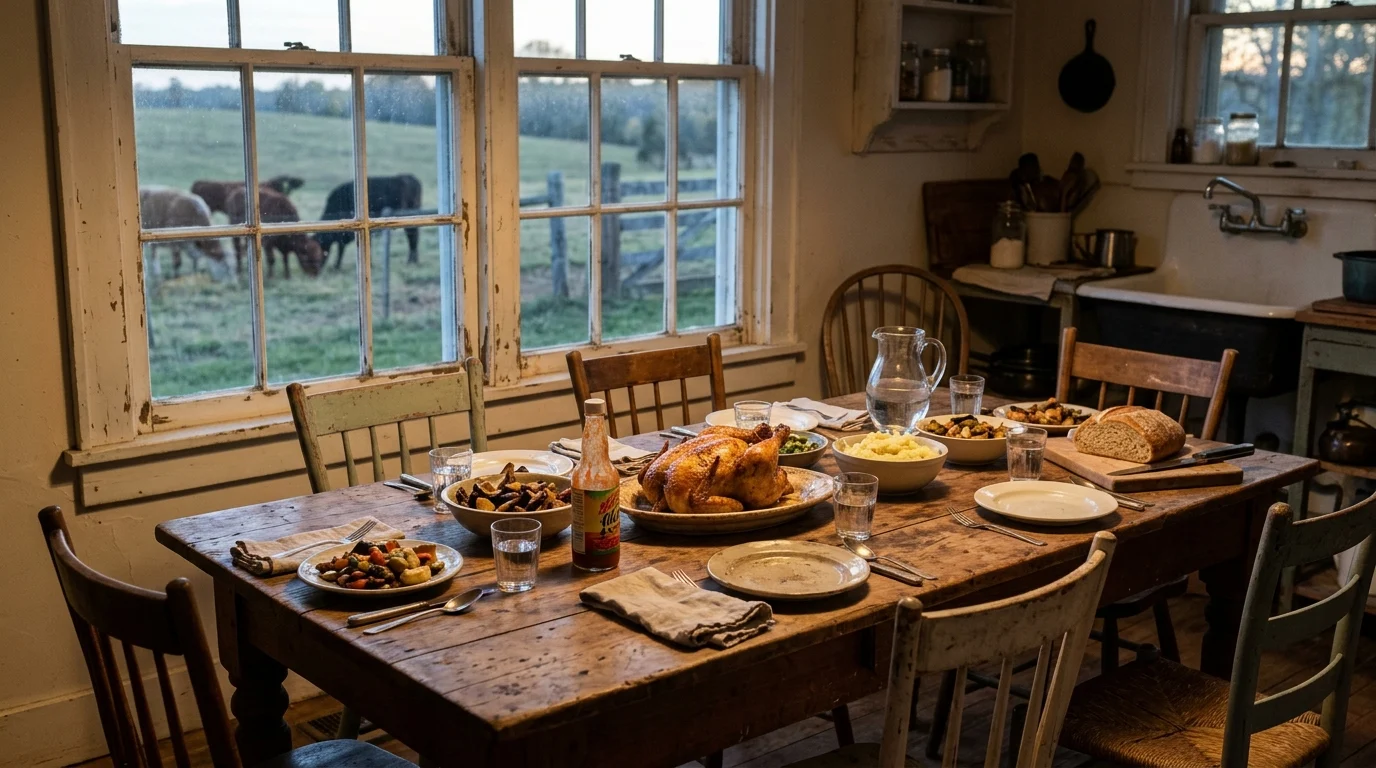
What she has instead is a market stall, a farm store that sources turkeys, milk, salt, hot sauce, and sourdough from other local producers so that eaters don't have to assemble a local diet alone, and a neighbour who tells her, "Kaylee, this brings so much value to my life… I don't ever want you to go anywhere." The Thanksgiving turkey anecdote ends the way these stories should: customers returning to say it was the best they had ever eaten, that "we can feel the love in the food we eat." That language sounds sentimental until you place it against Corvinelli's diagnosis of a loneliness epidemic and her observation that food is self-care, that we eat three times a day, and that no one "is eating good quality food" in a society that has forgotten how to sit around a fire together. Her dream of a farmer-owned grocery store or food co-op is the same idea at larger scale — a place where paying for food means "allowing another local family to survive and to live."
The synthesis is almost embarrassingly simple, which is what makes it credible. Corvinelli does not claim to have solved burnout; she names it and keeps working. What she offers instead is a set of smaller, more honest moves: expect ten percent rather than a hundred, invite the eater into the risk, and put yourself at a table where other people are trying to do the same. The antidote to a system that demands everything is not a better individual, but a community that shares the weight.
Related Episode
Themes
- Burnout as a Structural Condition, Not a Scheduling Failure
- Shared Risk Through the Herd to Harvest Collective
- Direct-to-Eater Sales as a Form of Community Infrastructure
- [object Object]
- The Farmer's Market as Antidote to the Loneliness Epidemic