Foresight Exercises Fail When They Internalize Assumptions Instead of Entertaining Competing Worldviews
When a room of agri-food practitioners split between hope and dread over the same 2022 scenarios, the fault line turned out to be the assumptions the exercise never put on the table.
Published November 16, 2026
The Same Book, Two Opposite Readings
The most instructive moment in a recent Future Herd book club was not anything the book said. It was the fact that two careful readers left it with opposite conclusions. Sherida Ryan found the 2022 foresight volume hopeful, a field guide to listening and keeping eyes and ears open as issues evolve. Elaine Power found it discouraging — an exercise that never questioned its own assumptions about power, capitalism and neoliberalism. Both readings were grounded in specific passages. Neither was wrong. That divergence is itself the finding.
A foresight exercise is usually judged on the plausibility of its scenarios. That is the wrong test. The better question is what a scenario leaves unspoken: which arrangements it treats as permanent, which actors it treats as inevitable, and which futures it quietly forecloses before the reader is invited to think. When those choices are internalized rather than surfaced, the exercise stops being a tool for thinking and becomes a program the reader is asked to accept.
When the Scenario Arrives Pre-Decided
Barb Scott-Cole put the problem in a precise image. Reading the scenarios felt like attending an event whose agenda is so restricted there is no room to participate — as though a meeting had been held before the event where all the action was settled. The domains were interesting. But the authors internalized assumptions they could have entertained as part of the scenario, which would have made the exercise genuinely interesting, and instead presented conclusions as conditions.
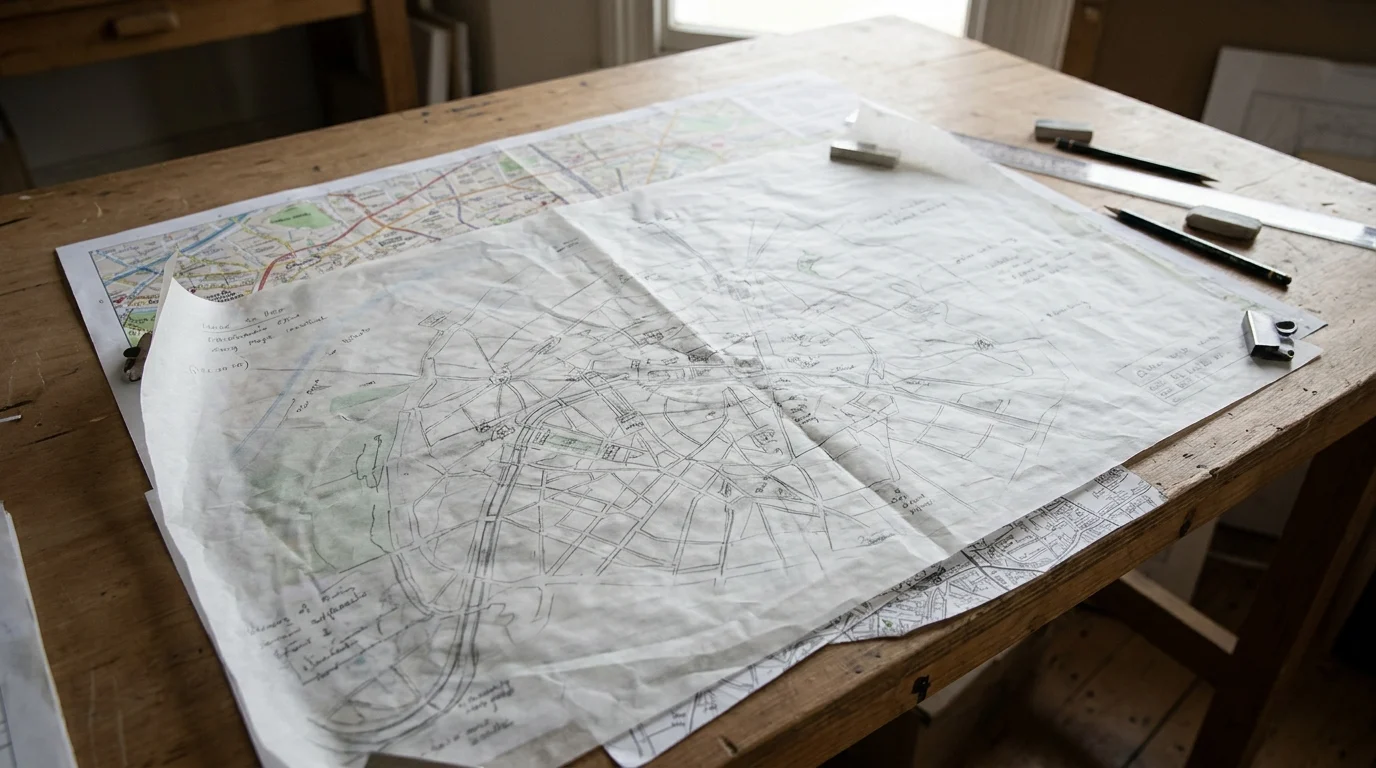
The anticipatory city case drew the sharpest reaction from the group, in part because everyone in the room has lived inside a city and has opinions about how it could respond better. The scenario proposed feeding civic data back to citizens so the public could discuss it — a genuinely appealing alternative to surrendering rights and simply saying, "technology, do it to me." Yet the chapter petered out. It never asked what would have to be true for a population to accept such a vision, or whether a data-collection infrastructure of that scale is compatible with the wellbeing it claims to serve. The case on cattle and cellular agriculture was, as several participants noted, unsatisfying in the same direction: cows are over, cellular agriculture is the destination, and the conversation has nowhere left to go. The problem is not that these outcomes are implausible. It is that determinism was baked in, and readers are always looking for an answer. Give them one, and they will take it.
What Never Got Named
Elaine Power's objection goes further than method. The book's assumptions about who holds power, how markets behave, and what neoliberal arrangements are fixed were never questioned. Set that against the four years since publication, in which tech oligarchs consolidated power, used personal data for surveillance and profit, and faced only partial accountability — lawsuits, citizen pushback, but no structural reversal. A scenario set that treats corporate data platforms as infrastructure rather than as political actors will look naive in hindsight, and it looked naive at the time to anyone outside the hype.
The group also noted that the text landed in 2022, arguably the peak of generative AI boosterism, and was written from an Asia-Pacific vantage point. That geographic perspective was a strength in one sense — Australia has been hit by climate disruption harder and earlier than most places, a fact the scenarios arguably underweighted given how much it now shapes agricultural thinking there. But the vantage point was never declared as such. Historians of the document will want to know what its authors could not see from where they stood. As one participant observed, a researcher who studies both the history of technology and speculative fiction understands that people's commitment to their vision of the present shapes how they write about the past and the future alike. The first loss of innocence in historical training is discovering how many lenses exist. Foresight work needs the same loss of innocence.
A Psychoanalysis of the Future
Tianna Brand's framing is the methodological correction the group circled around. Any emerging-issues analysis should begin with a psychoanalysis of the vision: whose worldview is producing it, what worldview the author is holding, and what systems are assumed to be stable enough to carry the projected future forward. When someone announces that a technology will arrive and transform things, the useful question is not whether it is clever, but what makes anyone believe the surrounding institutions will hold. Present the same set of signals to different communities and you get different futures, because commitments made in the present are how futures actually roll out. A hopeful image tends to produce hopeful decisions; a resigned one produces resignation.
This is where speculative fiction earns its place beside horizon scanning. Cellular agriculture appears throughout science fiction — every space station runs on fermented food product — and that imaginative pull matters even if the technology is never practically viable. It is calling to something. Grounding that appeal in evidence is the work: the group pointed to Sidewalk Labs as the kind of concrete case the chapters needed, and to real-world instances where promised data platforms proved less live, less integrated and less powerful than advertised. Human beings throw spanners into works regardless of ideology. Nothing is guaranteed, and that is not a defect in the future so much as a description of how it is built.
Designing for Competing Theories
The closing exchange suggested a repair. Jesse Hirsh has begun asking guests for their theory of food, their theory of change, their theory of hunger — a small move toward the metacognition the conversation demanded. Sherida Ryan's correction was the sharpest line of the session: a theory is not a fact. A theory is something meant to be challenged and tested. If a foresight exercise published its parameters the way a disease model declares its assumptions and confidence intervals, readers could argue with it instead of absorbing it.
Jennifer MacTavish's mediation practice offers the interpersonal version: hold your own view and the person across from you in high regard at the same time, and let two things be true together. That is what the group did successfully for two hours — hope and dread, techno-solutionism and structural critique, in the same room without collapse. The natural conclusion is that these exercises should be collaborative by design, because shared sensemaking mitigates both the doomsayer and the rescuer, and because individuals cannot respond to climate disruption or food insecurity alone. Signals that used to arrive on a common evening broadcast now contradict one another by source, and people avoid them not from stupidity but because they are large and frightening. A scenario process that surfaces worldviews, declares assumptions and invites competing readings is not a softer exercise. It is a harder and more honest one.
Related Episode
Themes
- Internalized Assumptions as Hidden Scenario Parameters
- Power, Capitalism and Neoliberalism Left Unexamined
- Whose Worldview Is Doing the Forecasting
- Signal Literacy and Collective Sensemaking
- Theories of X as Contestable, Not Factual