54: Foresight Exercises Should Foster Curiosity, Not Convergence
Episode 54 · November 16, 2026
Jesse Hirsh and a panel including Barb Scott-Cole, Jennifer MacTavish, Elaine Power, Tianna Brand, Jeanette Herrle and Sherida Ryan dissect a 2022 Asia-Pacific foresight field guide and find its real value in method rather than prediction. The central argument: scenario work that hardens assumptions about technology, power and inevitability narrows futures, while good foresight should surface worldviews and hold multiple possibilities lightly. Tianna Brand frames this as interrogating whose vision of the future is on offer, and the group concludes these exercises belong in collaborative settings that build collective curiosity instead of consensus.
Overview
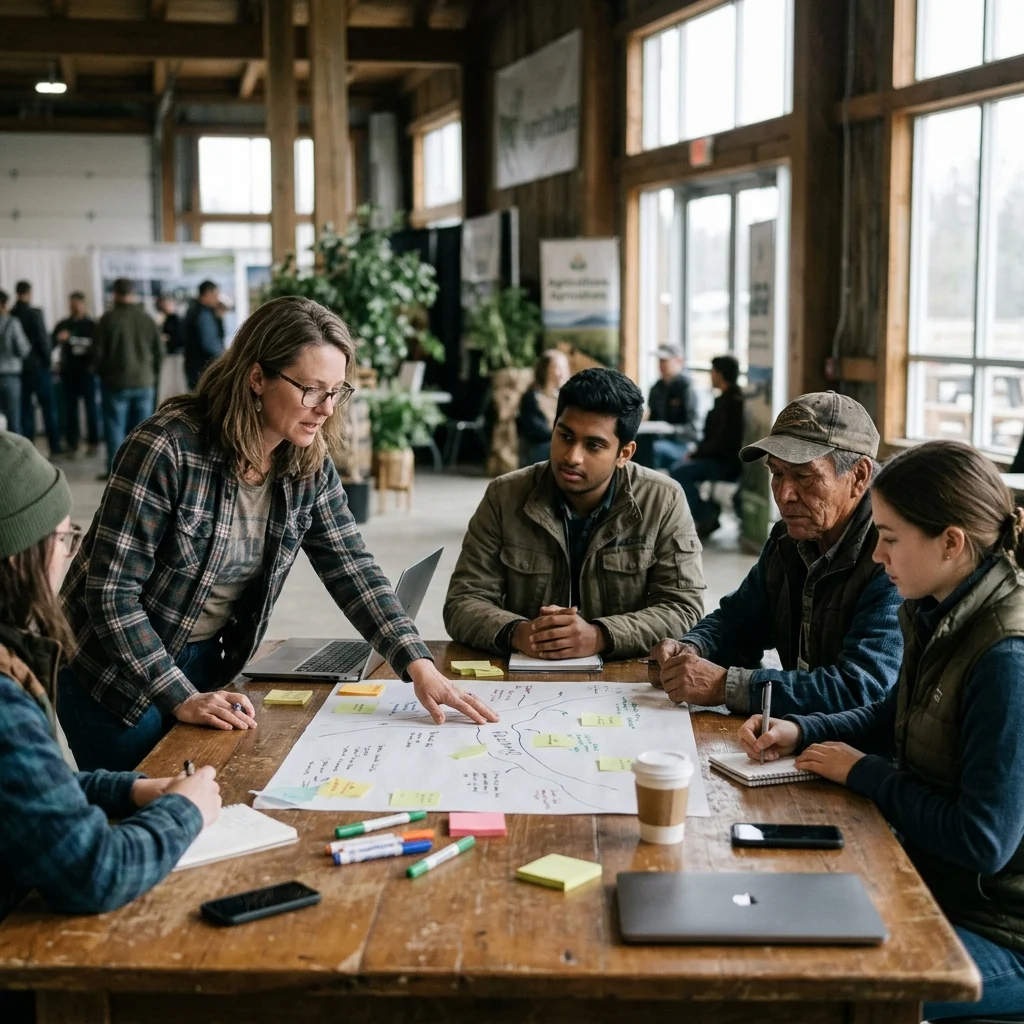
Jennifer MacTavish gathers Barb Scott-Cole, Elaine Power, Tianna Brand, Jeanette Herrle, Jesse Hirsh, and Sherida Ryan for a book-club style teardown of a 2022 foresight field guide on emerging issues, written largely from an Asia-Pacific vantage point. The chapters on the anticipatory city, cellular agriculture, women taking the lead and learning prompt a shared central question: is foresight meant to hand decision makers answers about what is coming, or to teach them how to notice, define and interrogate issues early? The group agrees the book works better as a method demonstration than as a set of predictions, and that its case studies stay frustratingly shallow.
Tianna Brand makes the methodological case most explicitly, arguing that the authors were showing how they interpreted signals through horizon scanning and issues analysis, and that every such exercise should declare its parameters and assumptions the way disease modelling does. She pushes further: foresight requires something like a psychoanalysis of the vision being offered, asking whose worldview it is and what existing systems would have to hold for it to come true. Barb Scott-Cole agrees the scenarios felt pre-baked, with assumptions that could have been opened up rather than internalized.
A productive split opens between hope and discouragement. Sherida Ryan finds the anticipatory city hopeful because it returns data to citizens for public deliberation rather than surrendering agency to technologists. Elaine Power finds the same chapters depressing, since power, capitalism, neoliberalism and tech oligarchies go unquestioned while obsessive personal data tracking distracts from poverty, housing and food security. Jesse Hirsh closes the loop on signal literacy, conspiracy and the illusion of control, arguing that scenario exercises should be collaborative, fostering collective curiosity so people can face hard signals without despair.
Listeners leave with a sharper kit for reading foresight work: name the assumptions, ask whose future is being described, and hold multiple worldviews in the same conversation. Jesse Hirsh offers the emerging phrase theory of blank, theory of food, theory of change as a metacognitive signal worth tracking, and Sherida Ryan lands the mic drop that a theory is not a fact but something meant to be challenged and tested. For Canadian agri-food leaders navigating cellular agriculture hype, climate signals, rural economies and food insecurity, that habit of questioning theories is the difference between convergence and genuine preparedness.
Key themes
- Foresight and scenarios
- Signal literacy
- Anticipatory cities
- Cellular agriculture
- Power and technology
- Collective curiosity