Edge Computing and Agentic AI Are Redefining What Precision Agriculture Actually Means
The real breakthrough isn't smarter sensors or bigger models — it's deciding which data never leaves the field in the first place.
Published June 24, 2026
Precision agriculture has always carried an implicit promise: that more data, collected more granularly, would produce better decisions. For decades, the architecture behind that promise was straightforward — sensors gather information, that information travels to a central platform, and the platform returns recommendations. The model worked tolerably well when the data volumes were manageable and when the value of centralisation was unquestioned. Both of those conditions are now breaking down simultaneously, and the conversation happening among the people building the next generation of Canadian agricultural AI suggests that the definition of precision itself is being renegotiated.
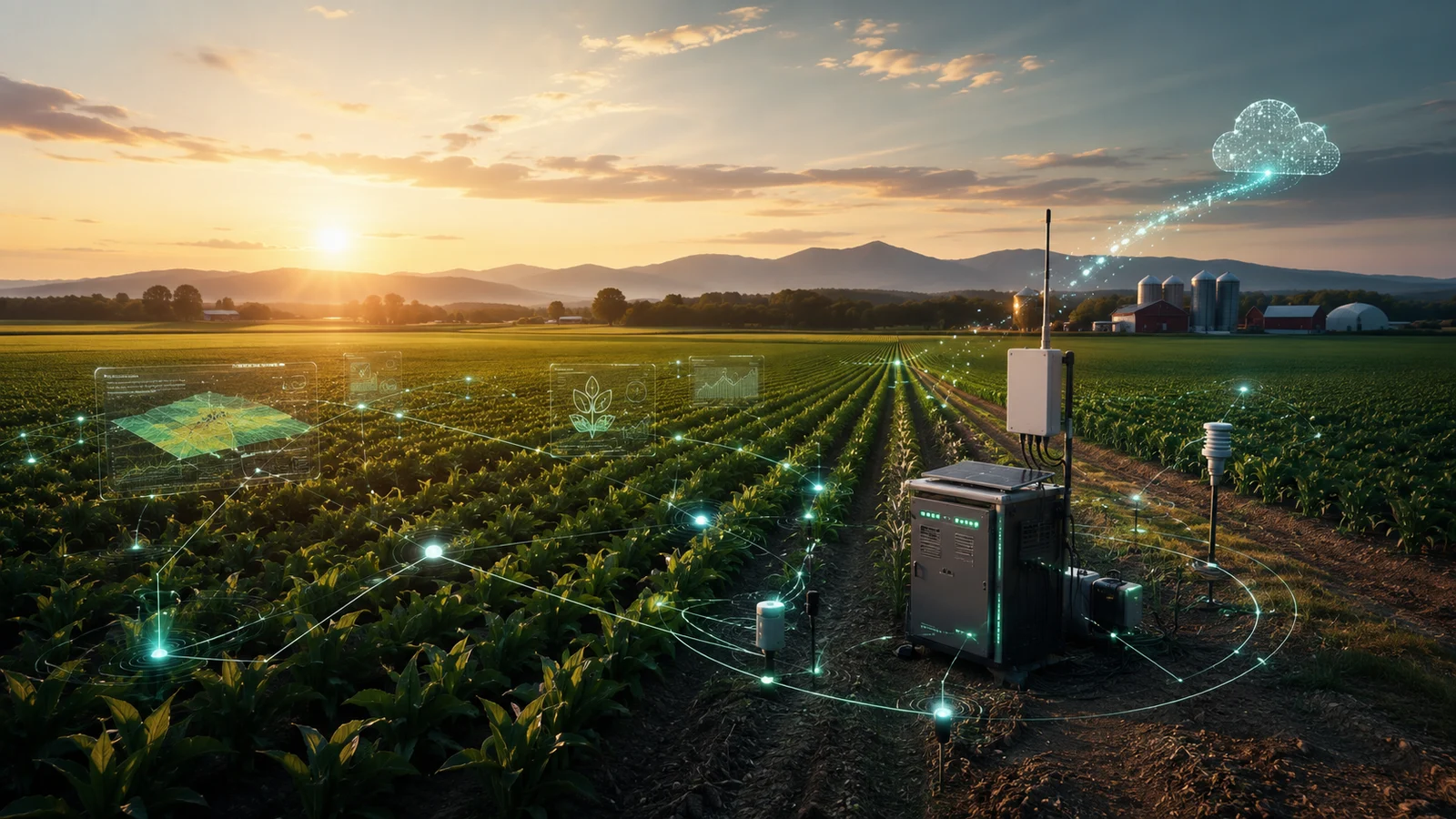
The clearest articulation of this shift came from Donald Killorn, whose team was literally on a rooftop in eastern PEI installing a WiFi gateway and building a mesh network at the same moment he was presenting a compute strategy to the Standing Committee on Agriculture in Ottawa. That simultaneity was not incidental — it captured precisely the tension at the centre of the new paradigm. Killorn's observation that precision agriculture is becoming about "what data needs to hit the main models and what data can be used inside the field boundaries in an inference model" is a significant reframe. It moves the design question away from data capture and toward data triage. The intelligence required to make that triage decision — to determine, in real time, which observations require the full processing power of a large foundation model and which can be resolved locally — is itself a form of AI. The system has to learn what it needs to learn centrally.
The computational stakes behind this architectural choice are not abstract. Killorn's team estimated that moving every data point from Canadian farms to centralised models would require approximately 200 gigawatt hours of electricity. By allowing the system to develop what he called "agentic memory" — an accumulated sense of what categories of inference can be handled at the edge — they believe that figure can be reduced to roughly a gigawatt and a half. That is not an incremental efficiency gain; it is a reduction by more than two orders of magnitude. For a country trying to simultaneously build a credible national AI strategy and a food security strategy, the overlap between those two policy documents is not rhetorical. The energy arithmetic of agricultural AI has direct implications for whether Canada can host its own compute capacity at a meaningful scale, which in turn determines whether the data governance commitments made to farmers can actually be honoured.
This is where the conversation between Killorn and Mohamad Yaghi becomes particularly instructive. Yaghi, who has spent considerable time travelling across Canadian provinces watching AI adoption in practice, reframed the central ROI question in a way that cuts through much of the noise around productivity metrics. The honest question, he argued, is not whether AI can save money but whether it helps producers make better decisions before capital is committed. That framing matters because it shifts the evaluation criteria from outputs to timing. Agricultural decisions — about inputs, about timing of operations, about variety selection — are characterised by long lead times and high irreversibility. A system that improves a decision made before a planting season has compounding value that a system improving post-hoc analysis does not. The $3.5 billion in economic losses attributed to 28,000 unfilled positions in Canadian agriculture, identified by the Canadian Agricultural Human Resources Council, is not a productivity problem that more sensors will solve. It is a labour allocation and decision-support problem, which is precisely where agentic AI — systems that can take sequences of actions autonomously within defined parameters — begins to carry genuine operational weight.
The data sovereignty question running through this conversation is not separable from the architecture question — it is the same question asked from a different angle. Yaghi pressed Killorn directly on the OEM problem: the major equipment manufacturers — John Deere, Case, New Holland — are among the largest generators of farm-level operational data in Canada, and the degree to which that data remains within Canadian jurisdiction is largely opaque. Killorn's account of engaging with the Agricultural Equipment Federation's AG-N connector standard, going through the full API compatibility process, and then encountering friction suggests that compliance with European interoperability regulations is not automatically translating into genuine openness in the North American market. The implication is that data sovereignty for Canadian farmers cannot be assumed from regulatory alignment alone; it requires an active strategy of building alternative platforms that give producers the option to work with equipment manufacturers without being locked into their proprietary data ecosystems.
Mohsen's contribution from the research side introduced a dimension that the field-deployment conversation tends to undervalue: the problem of dark data. In a breeding programme working with 200,000 individual plants, selection focuses on a small fraction of the population. The remaining observational data — on plants that were evaluated and not selected — is archived and largely forgotten. Mohsen's argument is that this data, which researchers have no particular proprietary attachment to and no operational reason to guard closely, represents exactly the kind of input that could train more robust agricultural AI models if there were appropriate institutional frameworks for sharing it. The bottleneck is not the data itself but the absence of a governance conversation that has established what responsible sharing looks like. His proposal — train models on institutional data within secured university networks, then share the resulting model outputs rather than the underlying datasets — is a reasonable middle path, though it also illustrates how much infrastructural work remains before Canadian agricultural research institutions can participate systematically in the AI development pipeline.
What emerges from all of this is a picture of precision agriculture that is considerably more architecturally complex than its original formulation, and considerably more political. The question of where inference happens — at the field boundary, at a national data centre, or on a server farm outside Canadian jurisdiction — is not a technical preference. It determines who captures the value generated by farm-level data, what the energy cost of agricultural AI will be, and whether the sovereignty commitments being made in policy documents have any operational meaning. The edge is not a compromise solution arrived at because centralised compute is expensive. It is the design choice around which a coherent Canadian approach to agricultural AI needs to be built — one where the system's intelligence includes knowing what it does not need to send home.
Related Episode
Themes
- Inference at the Field Boundary
- Data Sovereignty as Business Risk Management
- ROI Before Capital Is Committed
- Agentic Memory and the Compute Cost Question
- Dark Data and the Archiving Problem