AI-Powered Plant Breeding: Reimagining Agricultural Research and Productivity
How computational methods can support crop improvement without replacing field evidence or the judgment of plant breeders
Published April 24, 2026 · Updated October 18, 2026
AI in plant breeding helps researchers work through genetic, crop-performance and environmental data to decide which possibilities deserve closer testing. It does not remove the need to grow plants, compare results across environments, or judge what makes a useful variety. In Episode 18 of The Future Herd, Dr. Mohsen Yoosefzadeh Najafabadi explains computational breeding as a meeting of those capabilities: biological knowledge, field experience and increasingly powerful ways to analyse data.
At the University of Guelph, his work connects plant breeding with computational biology. The university's research profile describes a dry-bean programme integrating quantitative genetics, AI, digital phenotyping and climate-scenario modelling. The practical question is not whether a computer can replace a breeder. It is how these methods can help breeders choose better questions, crosses and experiments.
What computational plant breeding changes
Plant breeding has long depended on systematic selection, genetics, experimentation and observation across generations. Computational methods extend that work by bringing different kinds of evidence together: genetic information, measurements of plant traits, imagery and environmental records. Machine learning can help identify relationships in these datasets and support predictions about crop performance.
In the conversation, Yoosefzadeh Najafabadi describes the effort involved in narrowing large populations of plants toward promising candidates. Models offer a way to investigate possibilities before committing scarce time and resources to every option. That is a change in how research effort can be directed, not proof that a predicted variety will succeed in a farmer's field.
The distinction matters for agricultural leadership. A faster analytical pipeline is useful only if it helps answer the right biological and practical questions. Which traits matter to growers and processors? Under what conditions does a promising result hold? What evidence would change the decision?
Digital twins and climate scenarios are tools for asking “what if?”
One possibility discussed in the episode is a digital twin: a computational representation used to explore how a crop might perform under different conditions. Yoosefzadeh Najafabadi connects historical crop and environmental records with scenarios for future growing conditions. This lets researchers investigate how temperature, precipitation or other conditions might affect breeding decisions.
These are conditional explorations, not precise forecasts of a particular farm's future. In the interview, he explicitly acknowledges that future scenarios are not completely accurate; their value is in giving researchers a basis for investigation. A model can help compare possibilities, but its usefulness depends on the evidence it draws on, the assumptions it makes and how its results are tested.
For climate adaptation, that changes the question from simply repeating past selection decisions to examining how those decisions might perform under different futures. It does not make climate uncertainty disappear.
Field validation remains part of the work
The episode also describes collaboration among researchers testing algorithms and pipelines in different locations. Validation is not a final formality after a model has delivered the answer. It is how researchers learn whether an approach travels beyond the conditions in which it was developed.
That is why claims that computational models can dispense with field trials miss the more useful story. Computational tools can support selection and experimentation; they do not establish biological performance by themselves. Field evidence, research judgment and the ability to recognize a model's limits remain central.
Human judgment and shared research capacity
Yoosefzadeh Najafabadi's account is also about cooperation. Computational breeding brings plant science into closer contact with data science, environmental modelling and software development. Researchers need ways to share methods and evidence, examine assumptions and test one another's results.
For farmers and agricultural institutions, the opportunity is not simply a new technology to purchase. It is a research capacity to shape: which crops and conditions receive attention, whose needs define useful traits, and how findings become trustworthy enough to guide decisions. Faster analysis can support that work, but it cannot decide those priorities on its own.
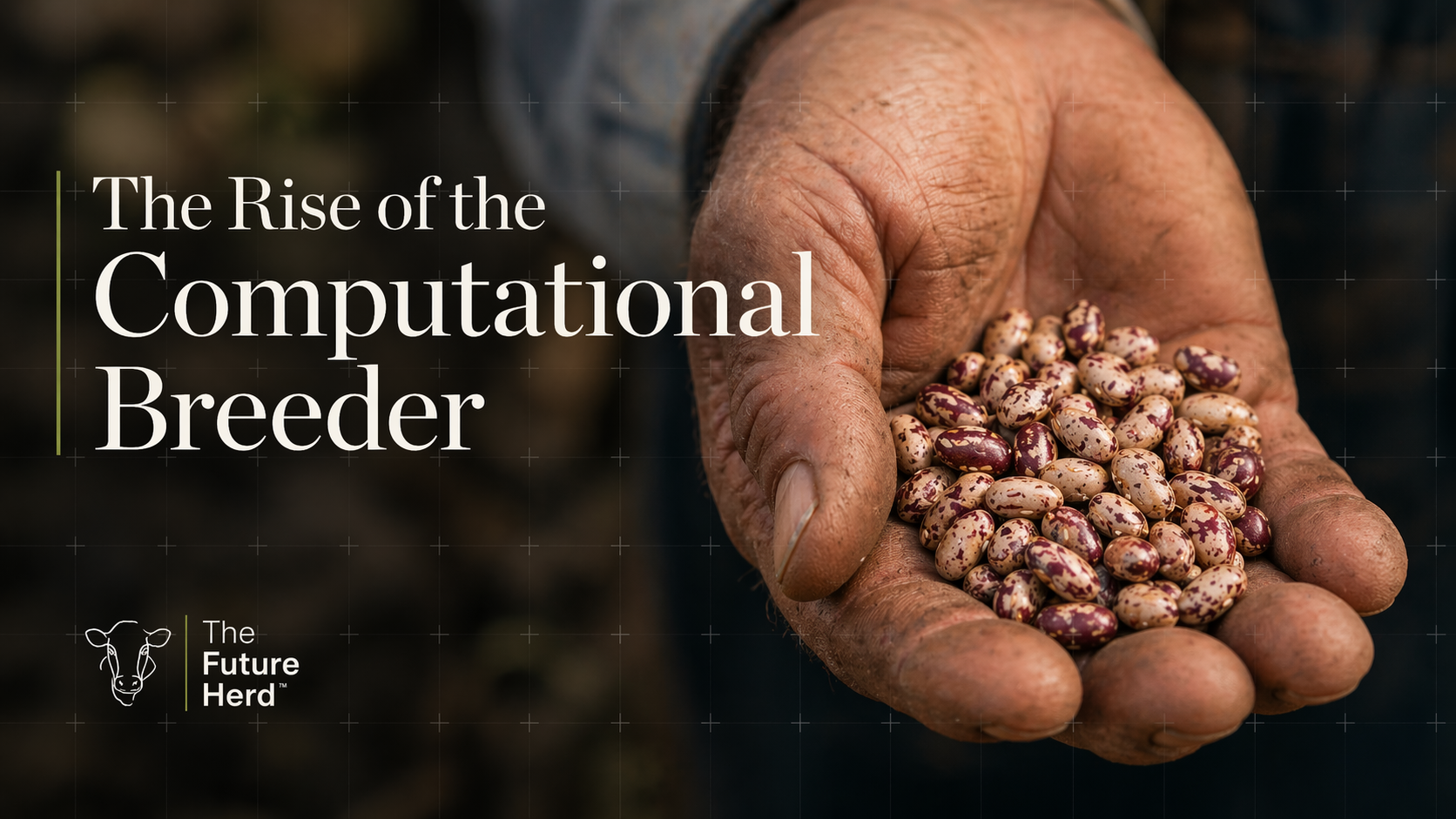
Listen to the full conversation on the rise of the computational breeder, or explore the broader AI in Canadian agriculture listening guide for conversations about farm data, infrastructure, governance and human judgment.
Sources and context
- The Future Herd, Episode 18: The Rise of the Computational Breeder — the conversation informing this article.
- University of Guelph: Mohsen Yoosefzadeh Najafabadi — institutional description of his research programme, consulted for this revision.
Related Episode
Themes
- Agricultural Innovation
- Artificial Intelligence
- Digital Agriculture
- Climate Adaptation
- Computational Science