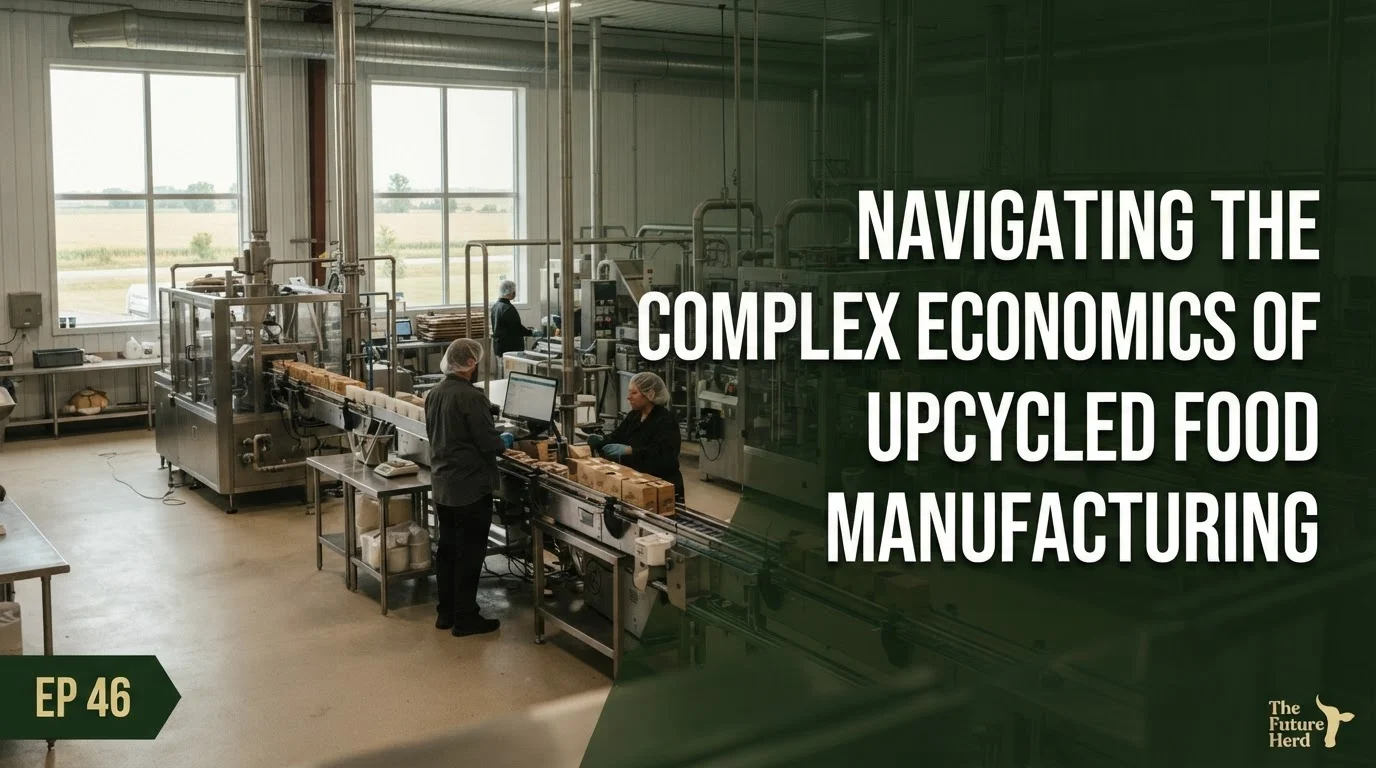
46: Navigating the Complex Economics of Upcycled Food Manufacturing
Episode 46 · October 14, 2026
In this episode, Dr. Alexandra Grygorczyk of Vineland Research explores the intricate economic realities of upcycled food manufacturing in Canada. She joins Jesse Hirsh to discuss why treating byproducts as valuable ingredients requires new supply chains, structural shifts in processing, and a careful approach to consumer psychology.
Overview
The agri-food sector often treats organic loss as an inevitable cost of doing business, but what if processing facilities were designed from the ground up to capture that value? In this episode of The Future Herd, host Jesse Hirsh is joined by Dr. Alexandra Grygorczyk, a research scientist at Vineland Research and Innovation Centre, to unpack the complex economics, supply chain dynamics, and consumer perceptions driving the upcycled food movement in Canada. Together, they explore how researchers and industry players are working to transform unavoidable byproducts into marketable ingredients.
A central insight from the conversation is that upcycling cannot succeed on novelty alone; it must compete on strict economic and functional terms. Grygorczyk explains that while innovators often view the "upcycled" label as a primary selling feature, it is really just a cherry on top. To be viable, an upcycled ingredient must meet rigorous market standards for pricing, functionality, and sensory appeal. Furthermore, food manufacturers looking to valorize their byproducts frequently hit roadblocks because doing so requires stepping outside their traditional business spheres, building entirely new supply chains, and forming novel partnerships.
The conversation also tackles the operational hurdles within food processing facilities, where the physical layout of a plant can inadvertently turn clean, nutrient-dense byproducts into waste. Grygorczyk shares a striking example from the greenhouse and vegetable processing sectors, where the moment a byproduct touches a non-food-grade surface or bin, it legally and practically becomes waste. Shifting this paradigm requires a cultural and structural change among producers, viewing byproducts not as garbage to be discarded, but as a secondary grade of food that requires deliberate diversion strategies before contamination occurs.
Listeners will take away a nuanced understanding of the intersection between food science, supply chain logistics, and consumer psychology. Grygorczyk notes that consumer acceptance hinges heavily on framing; while terms involving "waste" can trigger unfounded food safety fears, framing upcycled foods around frugality and resource efficiency resonates powerfully. As Canada establishes its own chapter of the Upcycled Food Association, this episode offers a vital look at why the agri-food sector must rethink its manufacturing infrastructure to build a truly sustainable and economically resilient food supply.
Key themes
- Upcycled Foods
- Food Science
- Supply Chain Logistics
- Food Waste Reduction
- Applied Research
- Consumer Perception