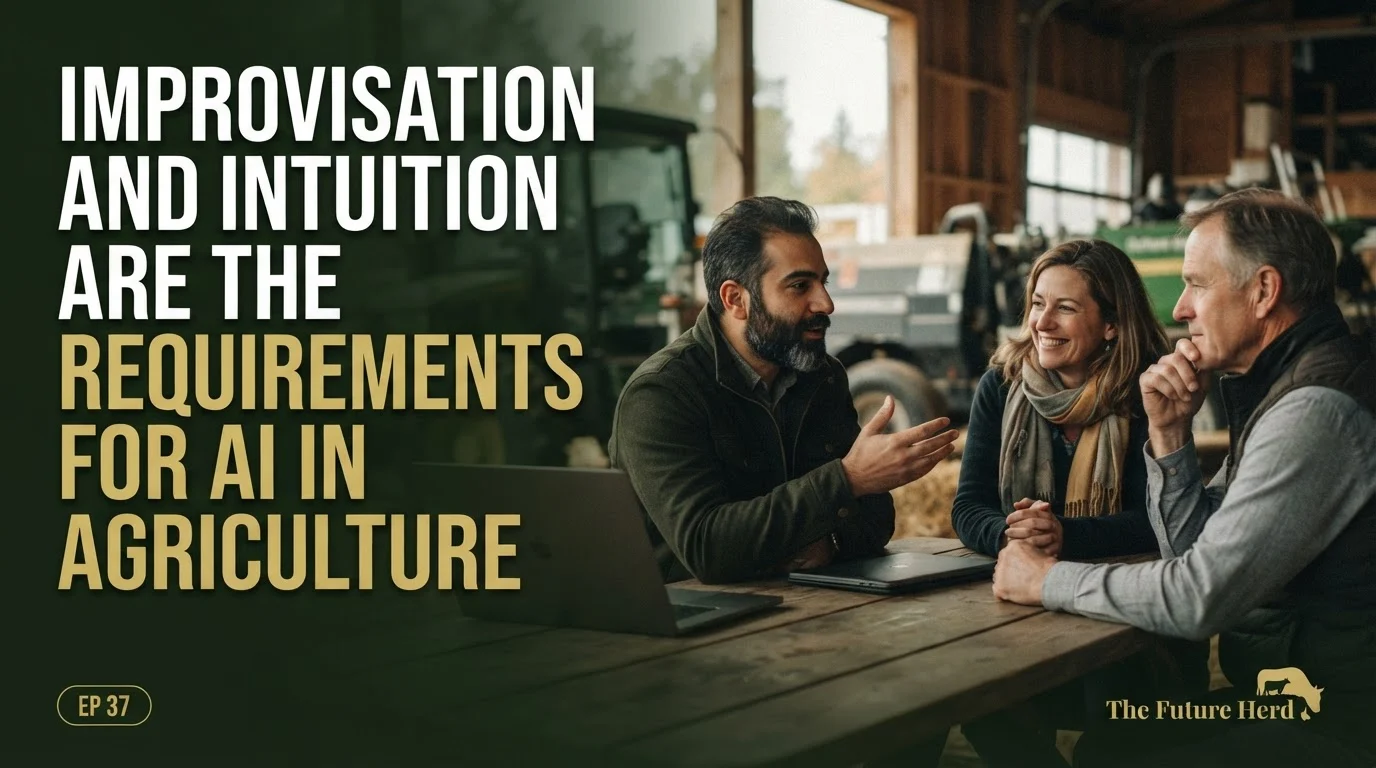
37: Improvisation and Intuition Are the Requirements for AI in Agriculture
Episode 37 · August 7, 2026
This episode explores how artificial intelligence functions in agriculture not as a tool of rigid control, but as a facilitator of human intuition and field-level improvisation. Host Jesse Hirsh is joined by Donald Killorn and Mohsen Yoosefzadeh Najafabadi to examine the practical, ethical, and computational realities of deploying AI across Canadian agri-food systems.
Overview
In this episode of The Future Herd, host Jesse Hirsh brings together two of Canada's leading voices on technology and agriculture—Donald Killorn and Mohsen Yoosefzadeh Najafabadi—to examine how artificial intelligence intersects with the day-to-day realities of farming and agri-food leadership. While AI is frequently marketed as a technology of absolute control and automation, agriculture presents a unique counter-narrative. Farming requires constant adaptation to unpredictable weather, volatile markets, and biological complexity, meaning that any effective technology must support—rather than replace—human intuition and improvisation.
Donald Killorn shares insights from the front lines of agricultural deployment in Prince Edward Island, detailing how his team manages the tension between blue-sky technological curiosity and the immediate operational needs of farmers. He discusses the architectural necessity of building localized "harnesses" and sentinel layers to protect sensitive farm data while leveraging large language models for complex tasks like carbon credit documentation and climate risk modeling. Killorn argues that the rollout of AI on farms is fundamentally an infrastructure and design challenge that demands human-centered aesthetics and rigorous cybersecurity.
Expanding on the research side, Mohsen Yoosefzadeh Najafabadi explores the intersection of computational biology, plant breeding, and artificial intelligence at the University of Guelph. He addresses the critical challenge of AI hallucination and data verification in research, warning that circular citation loops by AI agents can skew scientific findings if not properly governed. Yoosefzadeh Najafabadi also introduces the revolutionary potential of quantum AI to process complex genetic and environmental combinations, offering a way to breed crop varieties tailored for the extreme climate conditions of the next decade.
The conversation closes with a grounded evaluation of the environmental costs associated with generative AI and the imperative of maintaining grower trust above all else. Listeners will walk away with a deeper appreciation for the governance, infrastructure, and leadership required to navigate the AI transition in Canada's agri-food sector thoughtfully, ensuring that technology serves as an enabler of freedom and resilience rather than a black-box constraint.
Key themes
- Artificial Intelligence
- Agricultural Technology
- Plant Breeding
- Climate Adaptation
- Data Governance
- Quantum AI