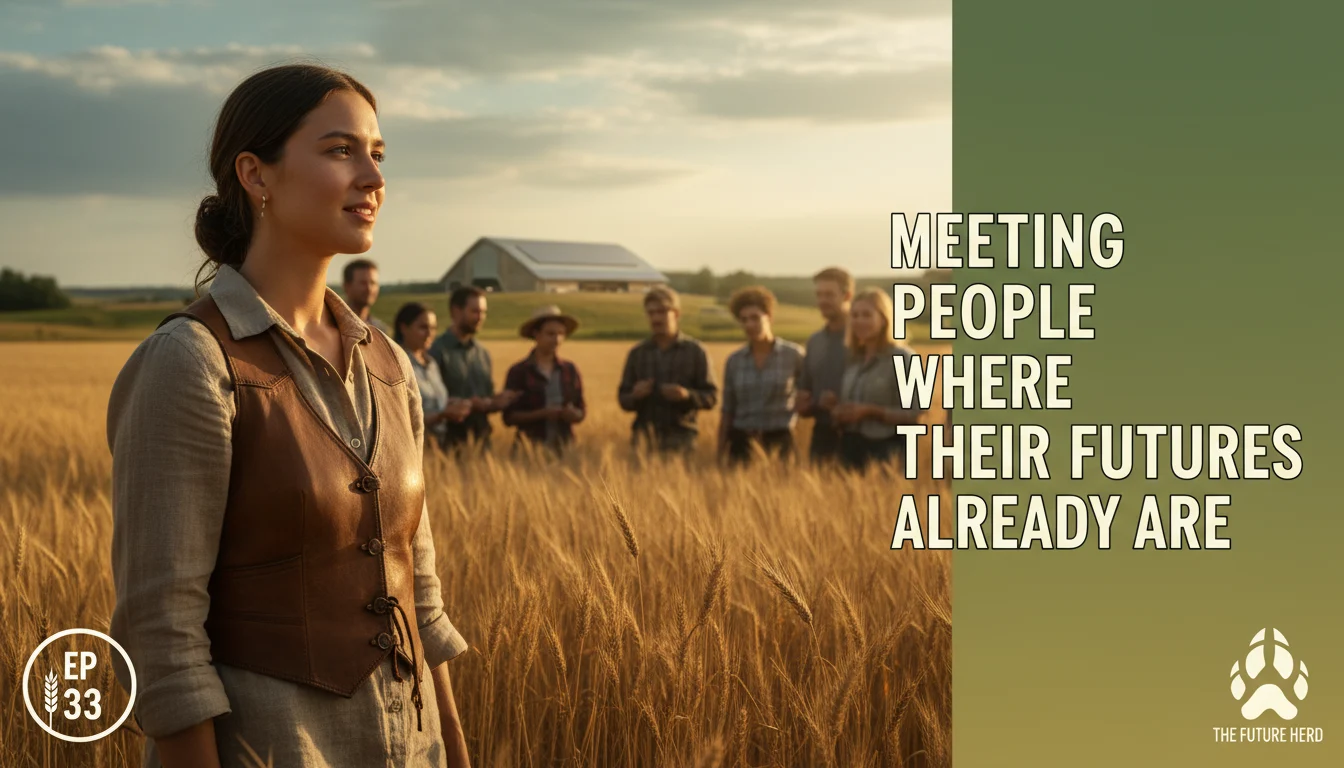
33: Meeting People Where Their Futures Already Are with Tianna Brand
Episode 33 · July 10, 2026
Tianna Brand is a foresight practitioner who spent years introducing futures thinking into one of the world's oldest international scientific bodies — the World Organisation for Animal Health — by working, as she puts it, by stealth. In this conversation with Jesse Hirsh, Brand makes the case that humility is not a soft quality but a practical leadership requirement, and that the challenge facing sectors like agri-food is not a lack of data but a failure to hold multiple futures at once. Her argument grounds foresight not in prediction or futurism-as-escape, but in agency: the recognition that we are already creating the conditions for what comes next, whether we acknowledge it or not.
Overview
Tianna Brand spent years doing something that sounds straightforward but rarely is: convincing rooms full of scientists, veterinarians, and policy experts at the World Organisation for Animal Health that imagining multiple futures is not a soft exercise — it is essential to responsible leadership. In this episode, Brand joins Jesse Hirsh and co-host Jen to unpack what foresight actually looks like inside institutions that run on evidence, and why the agri-food sector, facing compounding pressures from climate, disease, trade disruption, and eroding trust, may need it more urgently than most. The central question the episode wrestles with is not whether the future can be predicted, but whether leaders are willing to hold it as plural — and what it costs them when they aren't.
Brand's entry point is the concept of humility, which she frames not as an abstract virtue but as a functional one. Nobody has been to the future and back, she argues, and the illusion of certainty — however commercially appealing in the dashboard era — is more likely to produce brittle decisions than good ones. The more perspectives you bring in, she suggests, the more plural the futures become, and that multiplicity is not a problem to be solved but a signal to be worked with. She draws on her experience at WOAH to describe how she introduced foresight thinking incrementally — not through grand institutional gestures, but by connecting it to methods organizations already trusted, like horizon scanning for emerging diseases and emergency management planning. The goal was never to replace evidence; it was to widen what counted as relevant information.
One of the episode's sharpest tensions emerges in a discussion of zoonotic disease risk, regulatory resistance among farmers, and the conspiracy and disinformation cultures that now shape how many rural communities receive scientific information. Brand's response is neither to dismiss the resistance nor to argue around it. Her prescription is direct: don't arrive with baked futures. Farmers, like any stakeholder group, already carry their own visions of what the future should look like, and those visions are shaped by lived experience, by a history of regulation that may have felt imposed rather than co-created, and by legitimate concerns about agency and control. What she calls "meeting people where they're at" is not a communications strategy; it is a foresight methodology — one that starts with what Josh Polchar, a colleague she cites, describes as what's in your head rather than what's ahead.
Brand also introduces the Three Horizons method — developed by Bill Sharpe and Tony Hodgson — as a practical framework for how the agri-food sector might map where it is, where it wants to go, and how to work through the messy, entrepreneurial middle ground between the two. What makes her application of it distinctive is her suggestion that strategies themselves might become story-books — documents that describe multiple futures as narratives, with characters whose leadership competencies can be tracked against the present-day behaviour of actual leaders. It is a pointed critique of conventional strategic planning, and an implicit argument that the legitimacy crisis facing many agricultural associations — the tendency to keep throwing out leaders before any seeds can be cultivated — reflects an organizational failure to hold time with enough patience or plurality.
Listeners will come away from this conversation with a more grounded understanding of what foresight actually demands from the people and organizations that take it seriously: not optimism, not prediction, but a willingness to suspend prior assumptions, take participation seriously as both a value and a method, and recognize that the futures we are most worried about are, in large part, futures we are already building. Brand's framing of agency — her insistence that we are creating the conditions for things like avian influenza outbreaks or collapsed regulatory trust, not merely experiencing them — is the kind of claim that sits uncomfortably but productively with anyone in a position to influence how Canada's food system evolves from here.
Key themes
- introducing foresight by stealth into science-driven organizations
- humility as a practical leadership tool in the face of uncertainty
- meeting farmers and stakeholders where their futures already are
- the Three Horizons method as a framework for agri-food transformation
- agency versus determinism in the face of compounding crises
- participation as the prerequisite for policy that actually works