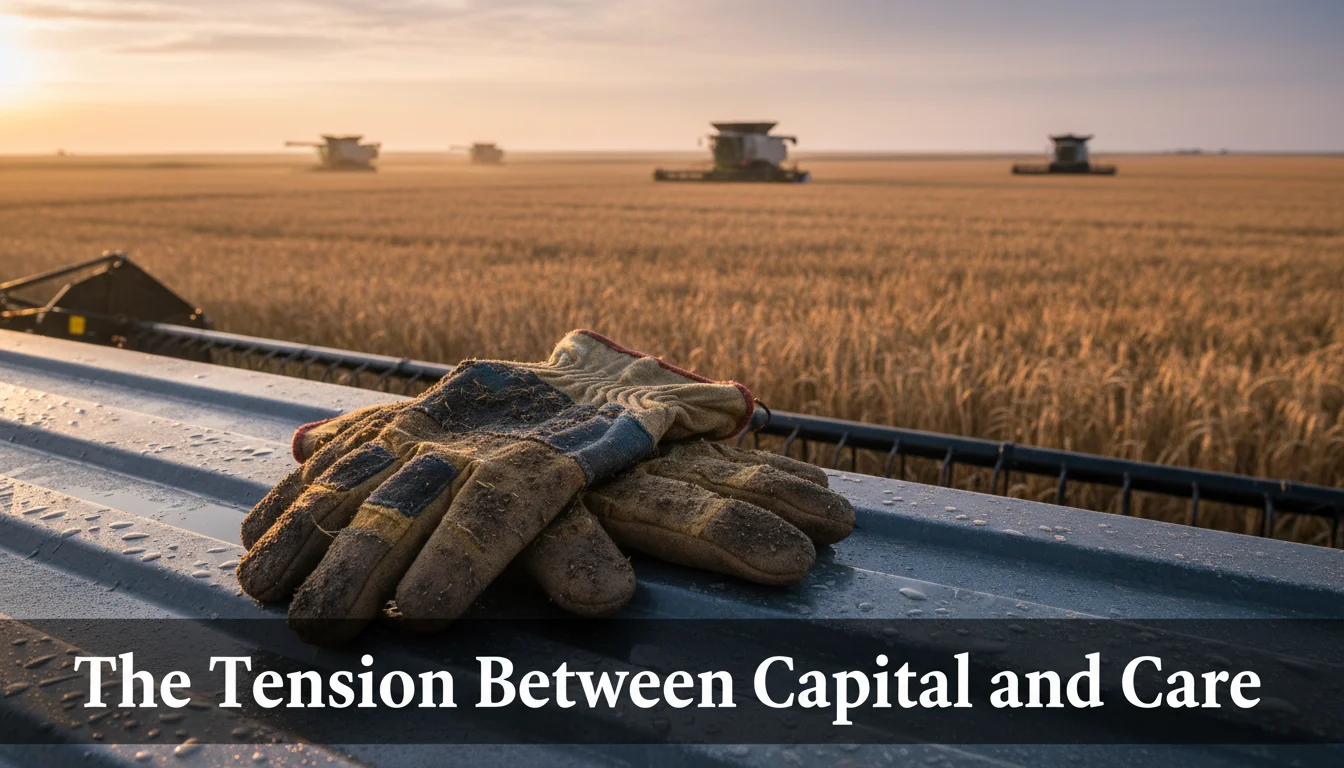
30: AgriFood Names the Tension Between Capital and Care with Elaine Power
Episode 30 · June 19, 2026
Elaine Power, associate professor at Queen's University, joins Jesse Hirsh for a conversation that refuses to soften the contradictions at the heart of Canada's food system. Power argues that the agri-food sector systematically renders invisible the labour that sustains it — from racialized farmworkers and underpaid grocery workers to the domestic kitchen — and that this invisibility is not incidental but structural. The episode names what many in the sector sense but rarely say plainly: that a food system built on the logic of capital cannot also be built on the logic of care.
Overview
Elaine Power has spent decades tracing the politics of what we eat — from her early encounter with Frances Moore Lappé's writing as an undergraduate in Nova Scotia, through years of practice as a dietitian, to her current work as a food systems scholar at Queen's University. In this conversation with Jesse Hirsh, she is not interested in softening the diagnosis. The agri-industrial food system, she argues, is structurally broken in ways that cannot be fixed by better labelling or smarter consumer choices. What this episode wrestles with is a harder question: if the system is built to extract value from food and from those who produce it, what would it actually mean to build something different?
One of the episode's most generative moments comes when Hirsh floats the idea that the term "agri-food" is itself politically loaded — that the "agri" side reflects the logic of capital and the "food" side reflects something closer to care, culture, and sustenance. Power finds the framing illuminating. She connects it to what she sees as capitalism's tendency to invert value: the big multinational food manufacturers, she argues, take cheap inputs and produce what food scholar Tony Winson called "pseudo-foods" — calorie-dense products engineered for profit, not for life. The system rewards those who extract, not those who nourish.
Power is particularly pointed on the question of labour. She traces the food system's invisible workforce from racialized temporary foreign workers doing backbreaking agricultural labour in Canadian fields, to grocery workers celebrated briefly as pandemic heroes before being returned to minimum wages and precarious schedules, to the domestic kitchen — historically feminized, chronically undervalued, and now increasingly offloaded to the very corporations that benefit from its devaluation. She sees a direct line between second-wave feminism's rejection of unpaid domestic work and the rise of ultra-processed convenience food: when society refused to value cooking, the market stepped in to commodify it. The result is a food system that profits from a problem it helped create.
What emerges from the conversation is a case for revaluing food labour in its entirety — not as a nostalgic return to the kitchen, but as a political project. Power and Hirsh circle around the paradox that food remains a source of genuine pleasure and human connection even as the systems that produce it are causing documented harm, from seaweed blooms choking the French coastline due to agricultural runoff, to families separated by seasonal migration programs. Power keeps returning to the classroom as a proving ground for this tension: her students see the evidence clearly, and yet they still ask how she stays hopeful. Her honest answer — she watches birds, she notices crocuses — is not a deflection. It is a signal that staying grounded in the material world of actual food, actual seasons, actual living things, may be a prerequisite for the kind of sustained thinking this moment demands.
Listeners will leave this episode with a sharper sense of why the food system feels simultaneously broken and indispensable, and why the language we use to describe it — agri-food, convenience, choice — often obscures more than it reveals. Power does not offer a tidy policy agenda, but she offers something arguably more useful: a clear-eyed account of what the system is actually doing, and who is paying the price for it. That kind of intellectual honesty, Hirsh suggests, is exactly what the sector needs more of.
Key themes
- The 'agri' and 'food' in agri-food represent irreconcilable political values
- Invisible and racialized labour as the foundation of the Canadian food supply
- Convenience culture as a mechanism for extracting value from domestic food work
- Second-wave feminism's ambivalence toward the kitchen and its corporate consequences
- Teaching food systems without inducing despair in the next generation
- Ultra-processed food as a vehicle for capital, not nourishment