Reversing the Rural Brain Drain Through Urban Agricultural Programs
By embedding working ecosystems into high school campuses, urban agricultural programs are transforming city youth from food consumers into the producers and system architects the agri-food sector urgently needs.
Published July 27, 2026
The dominant narrative surrounding the Canadian agri-food sector has long been one of urban detachment and rural extraction. For generations, the trajectory of ambition pointed one way: young people leaving rural communities for urban centers, taking their talent away from the primary industries that sustain the country. Simultaneously, cities have been viewed as terminal consumers of food—vast markets where populations eat what is brought in from afar without a foundational understanding of the systems required to produce it. Yet this binary view of rural production and urban consumption overlooks a quiet, highly effective counter-movement happening inside city limits. By integrating applied agricultural infrastructure directly into urban secondary schools, educators are proving that the reversal of the rural brain drain does not begin in the countryside; it starts on the asphalt of the city.
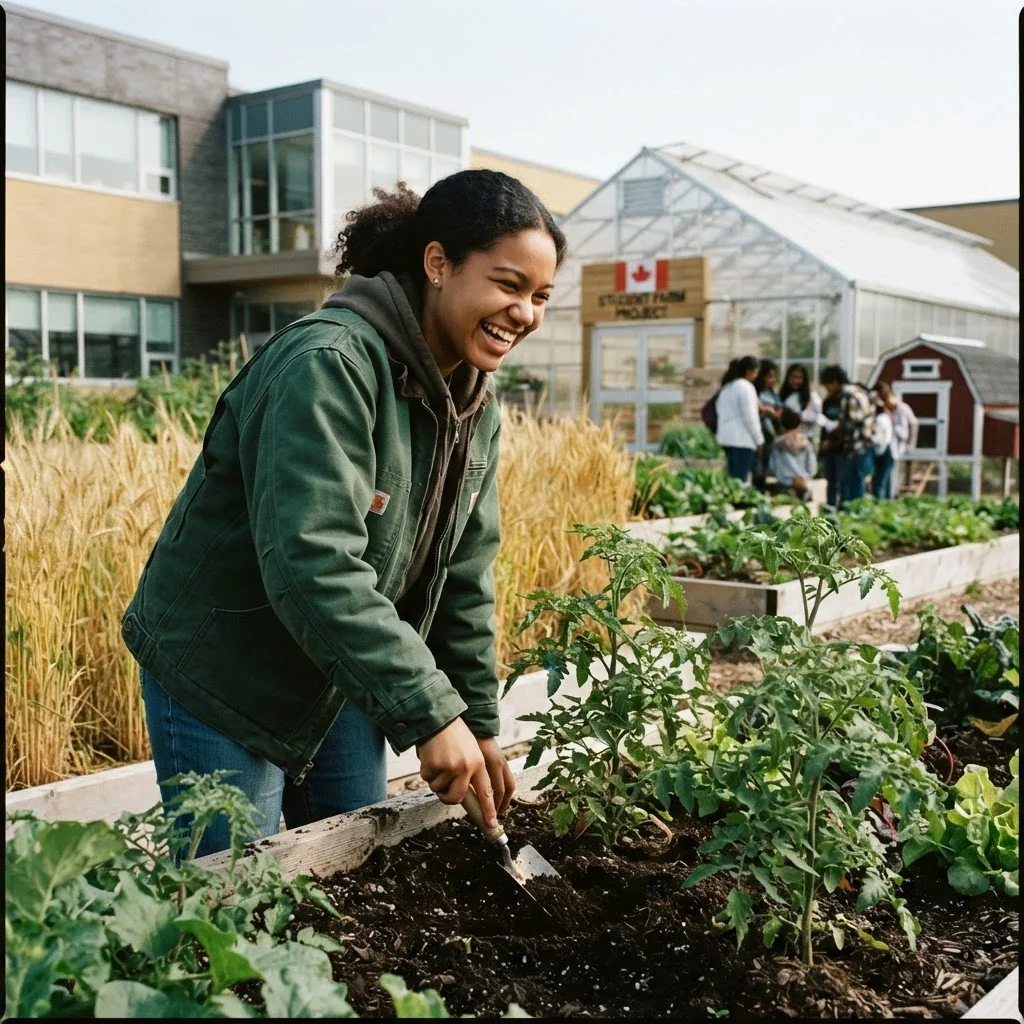
The mechanics of this reversal rely on rethinking what a school campus can be. For over two decades at Don Mills Collegiate in Toronto, educator Dan Kunanec has systematically dismantled the traditional, siloed classroom model by turning the school’s physical property into a working agricultural campus. This approach rejects the idea that vocational or trade-based learning is a lesser stream, operating instead on the principle that the physical creation of spaces—whether building an aquaponic system, planting an orchard, or constructing a wood-fired oven—is a rigorous academic enterprise. When students are tasked with the complete life cycle of food, from seed collection to the milling of grain and the baking of bread, abstract scientific and social concepts suddenly become tactile and urgent. Botany, climate change mitigation, soil science, and cultural history are no longer isolated chapters in a textbook; they are active variables in a communal project.
Crucially, this model challenges the notion that urban youth are inherently disconnected from the realities of food production. In diverse urban settings, students bring rich cultural histories and family foodways into the classroom, turning discussions around seasonality, fermentation, and peasant agriculture into shared community experiences. When a student can connect the preservation techniques of their grandparents to the management of a campus vineyard or an indigenous mound garden, agriculture ceases to be a distant, industrial abstraction. Instead, it becomes a accessible, culturally resonant field of possibility. This daily proximity to growing food shifts the baseline of food literacy, altering how students navigate grocery stores, evaluate nutritional value, and understand the true cost of convenience.
The broader implication for the agri-food sector is profound. The industry faces an acute succession crisis and a desperate need for fresh talent, ideas, and technological literacy. However, the solutions to these labor and innovation gaps will not come from passively hoping urban youth migrate outward. They require deliberate touchpoints that introduce young people to the vast, multidisciplinary nature of contemporary agriculture while they are still forming their career identities. Urban agriculture programs demonstrate that the agri-food sector is not a closed loop reserved for those born into farm families; it is an open, highly accessible domain that requires urban planners, marketers, engineers, hospitality professionals, and technologists just as much as it requires primary producers.
When urban high school students experience the tangible satisfaction of growing produce that is eventually served in Michelin-recognized restaurants—or used to feed food-insecure families during a crisis—their relationship to the industry changes fundamentally. They begin to see themselves not merely as consumers at the end of a long supply chain, but as active participants in a circular food economy. By cultivating this understanding within the city, educators are doing more than just teaching students how to grow food; they are growing the next generation of farmers, policy-makers, and food system architects, proving that the future of Canadian agriculture relies heavily on the talent waiting right in our own backyards.
Related Episode
Themes
- Experiential Learning
- Urban Agriculture
- Food Literacy
- Agri-Food Talent Pipeline