
Modular Farming Infrastructure Scales Local Production Without Environmental Compromise
By replacing centralized monoculture with adaptable, community-anchored processing units, regional food producers can bypass the logistical choke points of the industrial food supply chain.
Published September 26, 2026
The contemporary North American food system operates on a logic of hyper-centralization. Since the post-World War II era, agriculture has increasingly deferred to economies of scale that prioritize consolidation over resilience. A striking manifestation of this arrangement is the heavy reliance on single geographic nodes—such as Salinas, California or specific growing regions in Mexico—to supply the vast majority of fresh produce across the continent. While this architecture achieves formidable logistical efficiency on paper, it introduces systemic vulnerabilities: heavy reliance on synthetic inputs, extensive carbon footprints tied to long-distance freight, and an acute disconnect between consumers and the origins of their sustenance. For communities seeking to cultivate regional food sovereignty, the barrier is rarely a lack of local growing capacity; rather, it is the absence of appropriate, accessible post-harvest infrastructure.
Large-scale commercial processing facilities and food hubs frequently require millions of capital dollars, years of regulatory navigation, and rigid site configurations that isolate them from actual growing fields. Small- and medium-scale producers attempting to bridge this gap through do-it-yourself methods routinely encounter punishing labor bottlenecks, burnout, and compliance hurdles. Addressing this structural deficit requires reimagining the tools of production not as monolithic, permanent architecture, but as responsive, modular assets. When processing, cold storage, and washing systems are designed to be deployed directly where food is harvested, the economics of local agriculture shift. Producers can drastically reduce the physical distance and time between harvest and preservation, eliminating the energy-intensive transit loops that characterize conventional supply chains.
The viability of this decentralized approach depends heavily on the organizational vehicle driving it. Traditional non-profit and charitable models often struggle with velocity, hindered by governance structures and bureaucratic red tape that slow down the pace of intervention. In contrast, social enterprise models offer the agility necessary to iterate rapidly, respond to site-specific conditions, and sustain profitability while pursuing explicit environmental and social mandates. Operating a farm enterprise within an urban or rural community without relying on synthetic inputs, single-use plastics, or long-haul transport proves that small-scale production can be economically viable. However, viability requires more than ideological commitment; it requires engineering the daily labor of farming to be manageable. By substituting manual, repetitive tasks—such as hand-spinning greens or hauling produce across inefficient layouts—with purpose-built, ergonomic equipment, producers can dramatically increase throughput without sacrificing organic principles.
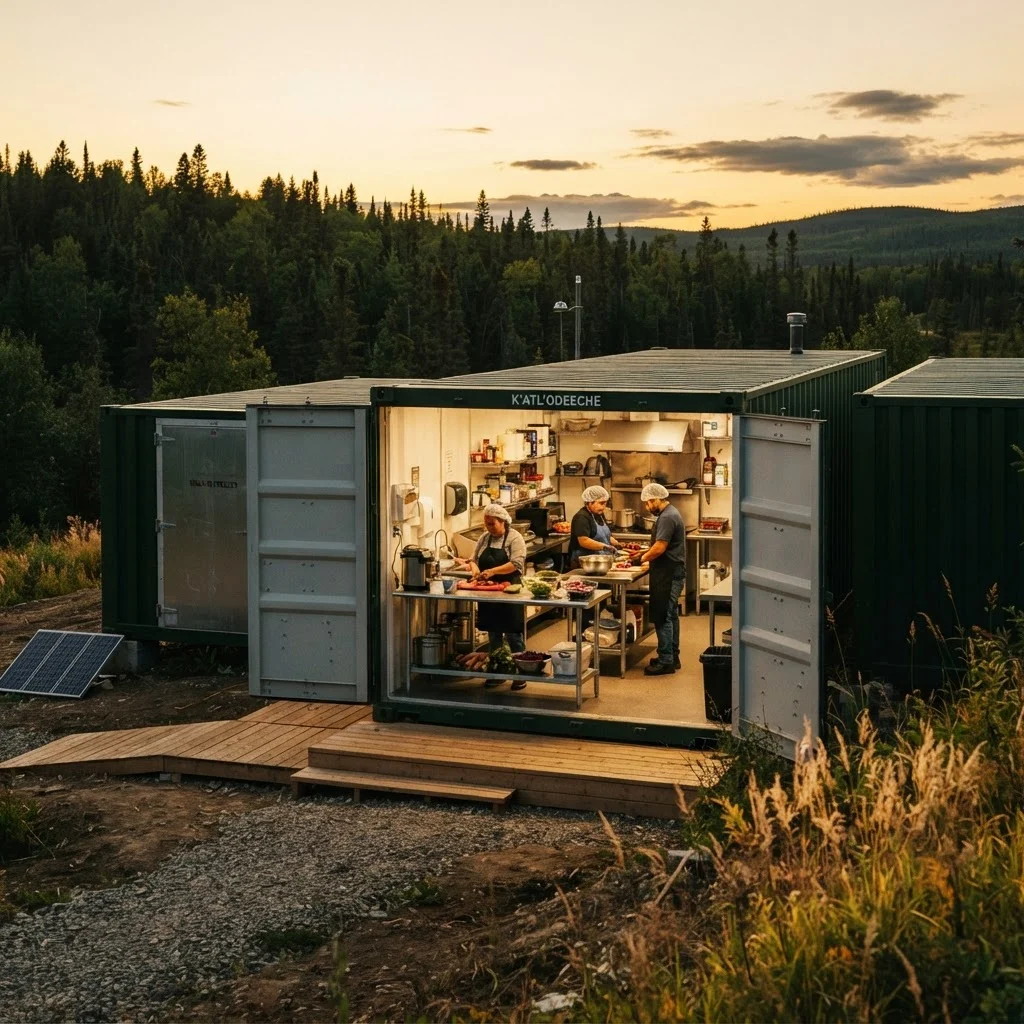
Modularity changes the risk profile of local infrastructure investments. Rather than locking a community into a fixed commercial kitchen that may sit underutilized or poorly located, pre-built, code-compliant modular units can be customized to match exact regional requirements—whether that means handling produce, wild game, seafood, or specialized crops like seaweed. Because these units are engineered to meet national building codes and food safety standards prior to delivery, they effectively absorb the regulatory friction that usually exhausts grassroots initiatives. This plug-and-play capability allows organizations to place cold storage and processing exactly where it serves the workflow best, whether adjacent to a crop row, alongside a river, or integrated into a regional distribution network.
Ultimately, scaling local food production is not about attempting to out-compere the industrial food system on its own terms of cheap monoculture and massive volume. It is about replacing mass production with production by the masses, activating the existing network of growers, hunters, and fishers already embedded within communities. By supplying these decentralized actors with high-quality, adaptable infrastructure that respects their autonomy and unique operating environments, the agri-food sector can dismantle its dependence on fragile supply lines. Modular farming infrastructure demonstrates that ecological responsibility and economic viability are not mutually exclusive; they are simply a matter of putting the right tools in the right place.
Related Episode
Themes
- Modular Infrastructure In Regional Food Systems
- Social Entrepreneurship Vs Non-Profit Bureaucracy
- De-Risking Small-Scale Farm Operations
- Direct-To-Consumer Distribution Economics