Strawberries, Agrivoltaics, and Open Source Hardware
Canada has almost no agrivoltaic data, and the fastest way to generate it may be to give away the designs for the equipment that collects it.
Published November 5, 2026
Joshua Pearce's account of agrivoltaics begins with a claim that sounds wrong. Give plants more sunlight and they grow more food, so the intuition goes; that is what farming is. Yet the research literature, and now the work at Western University's farm, says otherwise. Nearly every crop has an optimum light level, and it is almost never full sun, particularly where irrigation is scarce. In Arizona, shading pepper plants with a photovoltaic module has produced roughly double the yield. Shade is cooler, wetter, and less windy, and the resulting microclimate can be more productive than open sky — but only if someone has done the work of finding out what the microclimate is for a specific crop, in a specific place.
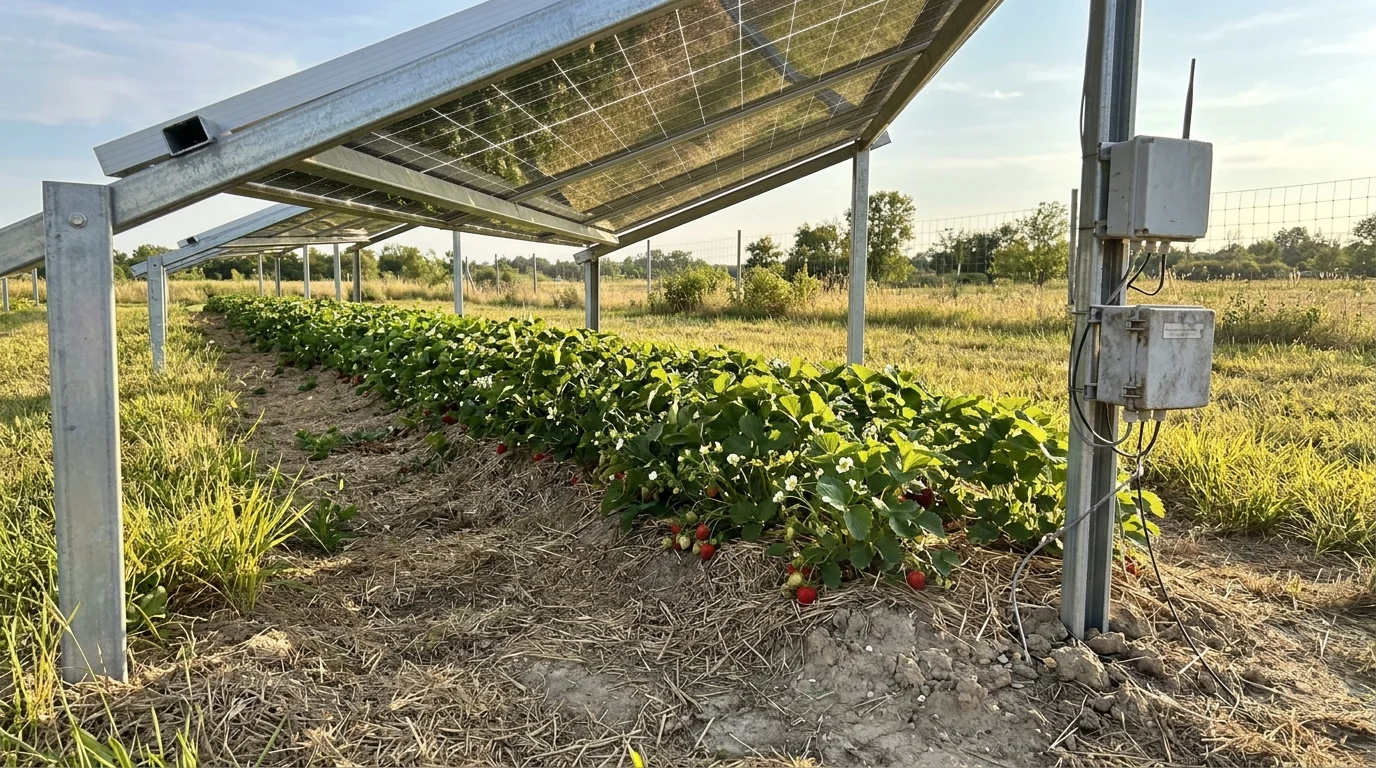
That work has not been done in Canada. Pearce notes there was essentially no Canadian agrivoltaic data when his group began, despite the sector being worth billions and despite Asia, Europe, and the United States moving quickly. His response was to build a deliberately awkward experiment: not one crop under one panel configuration, as most trials do, but dozens of different photovoltaic racking systems laid out at the Elora farm, with crops rotating through them season by season. The results so far — eighteen percent more strawberries under the best-performing panel, higher yields for turnips, lettuce, and amaranth, inconclusive soy, promising but unconfirmed corn — are less a conclusion than a demonstration of method. The bottleneck is time. A crop takes a year.
This is where the article's real subject enters, because the racking designs used in that experiment are released as open source hardware. Anyone can copy them or commercialise them. That decision is not a gesture of academic generosity attached to the agrivoltaics work; it is the mechanism by which a data-poor country might catch up to one where the evidence already exists. And it rests on a longer argument Pearce has been making since a broken filter wheel changer nearly cost him a summer at Michigan Tech.
Pearce's route into open source hardware ran through a $2,500 replacement part with a fifteen-week lead time and a machine that sat idle while he waited. With scrap computers, an Arduino, a 3D printer, and a high school student trained in a week, his lab built a better one. The underlying enabler was the RepRap project — Adrian Bowyer's self-replicating printer at Bath, released under a licence requiring that improvements be shared under the same terms. What followed is the clearest empirical case for the model: two students and a summer for the first fragile build, one student and a semester for a machine that was better in every measurable way, and eventually a desktop printing market that annihilated industrial rapid prototypers costing half a million dollars. The Arduino, released when an Italian design school faced closure, became the platform beneath an uncountable number of projects. Pearce's point is blunt. A company cannot compete with everyone else hacking on the same design, because a company is not everyone else.
Applied to agricultural science, this resolves a specific and well-known problem: the replication crisis. If a researcher in Germany publishes a result, a Canadian lab cannot reliably reproduce it without knowing whether the equipment or the reagents differed. Shared digital designs — downloadable, manufacturable on a CNC mill or a laser cutter or a printer — make the instruments identical by construction. In Pearce's group the effect compounds: roughly fifty papers a year against a departmental average of six, collaborations with some eighty-five non-Canadian partners in a single year, and a one-day company formation protocol in place of the multi-year tech transfer pipeline that leaves discoveries sitting in a lawyer's queue. When the work is open, industry collaboration gets easier rather than harder, since a partner can take a design and commercialise it without negotiation. The claim is not that openness is virtuous. It is that it is faster, and that speed is the advantage.
Speed matters here because agrivoltaics in Canada is racing a gap in evidence, and because the farmer is the natural co-producer of that evidence. Pearce offered to send a data logger to the host's small orchard and pasture installation so it could start collecting measurements to share globally. That offer captures the architecture of the whole endeavour: designs are released, and the deployment becomes the instrument. A research question that cannot be answered by one lab with one field can be answered by many sites running identical, cheap, repairable hardware — provided the hardware is cheap and repairable. Racking, sensor arrays, fertigation controllers, ball mills, glove boxes, battery testers: in Pearce's lab each is an open design, and the cost difference is typically an order of magnitude, sometimes two.
The same logic extends to what happens when the equipment is on the farm and something goes wrong. Pearce's response to the cybersecurity objection is grounded in the security literature: open source systems are measurably more secure than closed ones, because scrutiny is not limited to the vendor. It is the same logic as repair. If the schematics, firmware, and bill of materials are available, a farmer can fix a controller or hire someone who can; if the system is proprietary, the choice is the manufacturer's goodwill or a replacement purchase. And when the equipment is networked and subsidised by data collection, the operator risks becoming the product — a point that sharpens considerably at national scale. Pearce's recent estimate that Canada could save a billion dollars over ten years with a sovereign Linux stack sits alongside a plainer observation: a foreign government could, in principle, compel a software vendor to disable machines that a country's government and farms depend on. The refrigeration sabotage in Europe is the small version. A shut-down combine fleet or a disabled pump is the large one. Food sovereignty, on this reading, is a technology-stack question, and closed agricultural machinery is a single point of failure.
None of this is free in the sense of costing nothing. Pearce is careful on that point: open source tractors, controllers, and solar systems must still be bought or built, and someone must be paid to maintain them. The claim is comparative cost and retained control. Nor does openness settle every question his lab raises — the thermal batteries and silicon-anode cells are years from deployment, the agri-tunnel's labour problem is unsolved, and controlled-environment agriculture remains a capital trap that has bankrupted firms on razor-thin margins. What open source changes is who gets to work on those problems, and how quickly the answers propagate.
Which returns the argument to a field in Ontario with a strawberry row under a translucent panel. The agrivoltaic result is promising; the method that produced it is the durable thing. A country with no data can either wait for proprietary trials to be sold to it, or it can publish the racking designs, ship data loggers to growers with panels in their pastures, and let the evidence accumulate across the network. Pearce's confidence that a photovoltaic food combination exists for nearly everything grown in Canada is a hypothesis. Open source hardware is what turns that hypothesis into a distributed experiment — and the farmers running it into researchers rather than customers.
Related Episode
Themes
- Agrivoltaics As Microclimate Design, Not Just Shading
- Open Hardware As A Reproducibility Fix For Agricultural Science
- Speed As The Real Competitive Advantage Of Openness
- Farm Infrastructure As A Sovereignty Question
- The Farmer As Data Collaborator Rather Than Customer