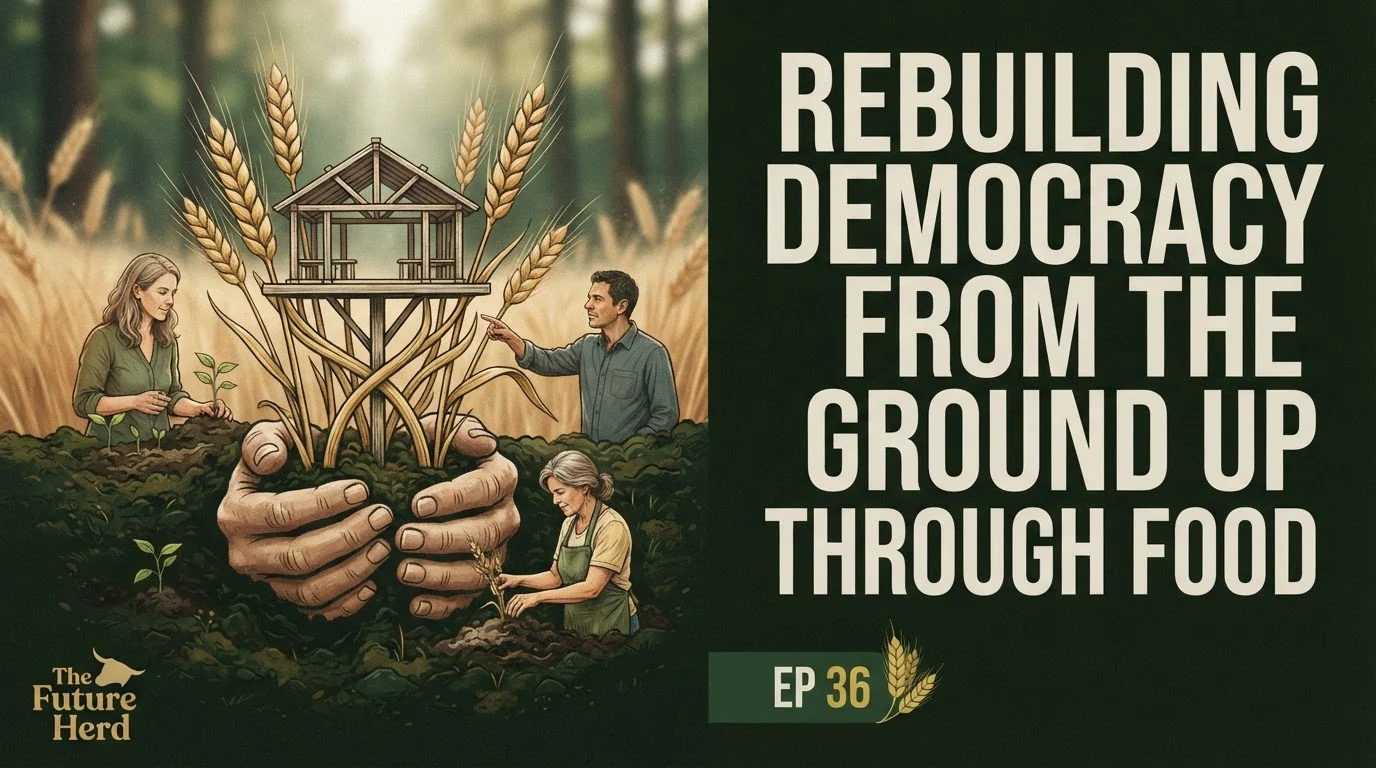
36: Rebuilding Democracy from the Ground Up Through Food
Episode 36 · August 5, 2026
Host Jesse Hirsh sits down with Alissa Overend, Charles Levkoe, and Elaine Power to dismantle the illusion of cheap food, corporate grocery monopolies, and the systemic capture of agricultural policy. Together, they argue that true food sovereignty requires moving past superficial market-driven fixes to reclaim food as a public good and a catalyst for democratic renewal.
Overview
In this episode of The Future Herd, host Jesse Hirsh is joined by food scholars and advocates Alissa Overend, Charles Levkoe, and Elaine Power for a rigorous examination of the Canadian agri-food sector. The conversation cuts past the comforting rhetoric of federal food strategies to confront a stark reality: an industrialized food system defined by extreme corporate concentration, captured regulatory bodies, and the externalization of ecological and human costs. The central argument challenges listeners to see food not merely as a retail commodity or a line item in a household budget, but as the foundational infrastructure of our democracy, health, and social fabric.
Opening the discussion, the panel tackles the myth of "cheap food," exposing how low sticker prices at the supermarket mask massive subsidies, exploited labor, and environmental degradation. With just five major grocery chains controlling roughly 80% of Canada's retail market—and two multinational firms dominating 95% of beef processing—the food chain operates as a consolidated oligopoly that squeezes primary producers while raking in record profits. The guests discuss how government interventions frequently amount to toothless market tinkering rather than addressing root structural problems, noting that corporate lobbyists enjoy direct backroom access that renders public consultation forums largely theatrical.
The conversation also explores the dangerous intersection of international trade agreements, deregulation, and surveillance capitalism within modern retail environments. From attempts to fast-track U.S. pesticide regulations to the rise of ag-gag laws that shield industrial slaughterhouses from public scrutiny, the panel outlines how policy is actively weaponized against public health and food sovereignty. Yet, despite these heavy structural barriers, the discussion pivots toward powerful counter-weights, including the vital insights held by front-line food workers, the necessity of evidence-backed policies like basic income, and the organizing potential of local food policy councils.
Ultimately, this episode offers both a sobering systemic critique and a hopeful call to action for Canada's agri-food sector. Listeners will walk away with a deeper understanding of why reforming the food system is inseparable from reforming our democracy itself. By shifting our perspective away from shareholder-driven models and toward human- and environment-centered governance, the episode proves that food remains one of our most potent arenas for building shared culture, demanding accountability, and finding common ground across a polarized society.
Key themes
- Food Sovereignty
- Corporate Concentration
- Agricultural Policy
- Democracy
- Food Distribution
- Labor Rights