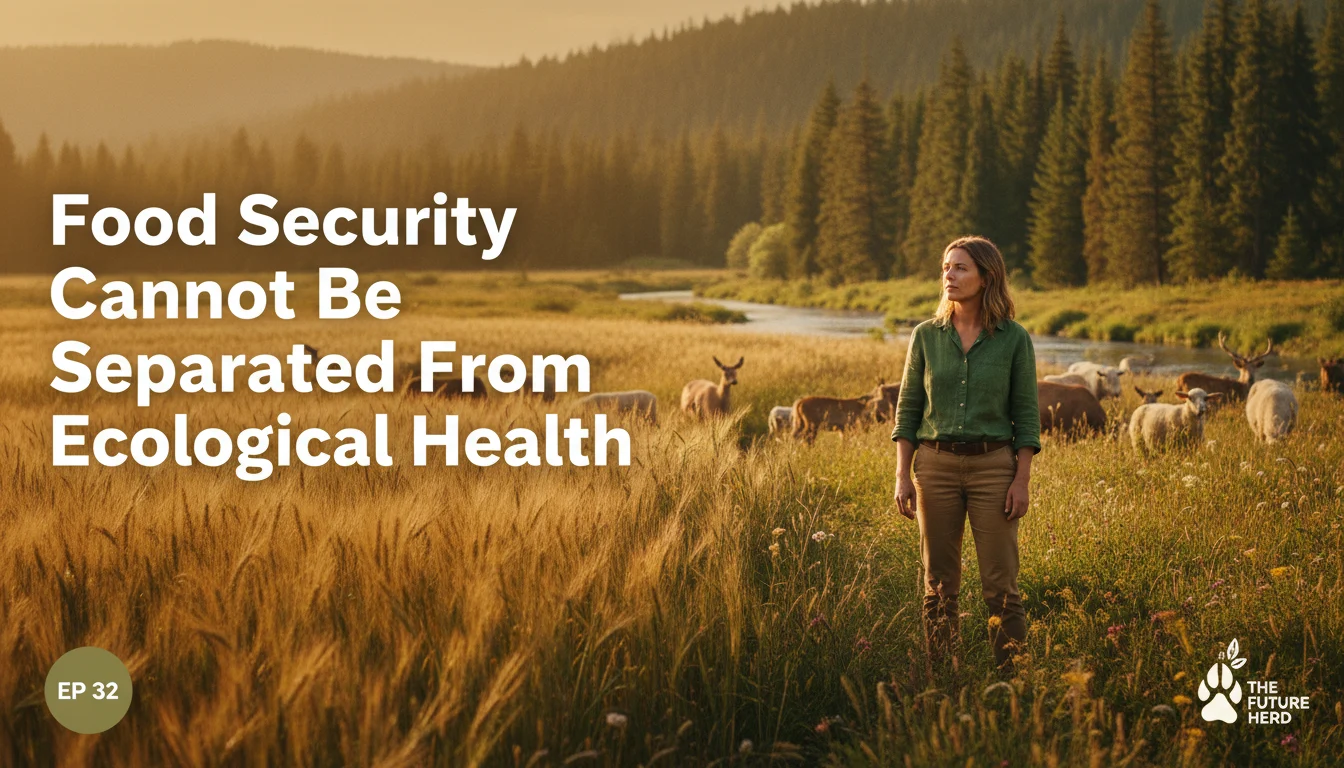
32: Food Security Cannot Be Separated From Ecological Health
Episode 32 · July 7, 2026
Sarah Elton — journalist-turned-academic and author of Locavore — argues that genuine food security requires expanding our definition of 'all' to include not just every human being but every organism and ecosystem that sustains the food system. Drawing on posthumanist theory, microbiology, and years of empirical research, she makes the case that health is not a condition possessed by individual bodies but a property that exists across socioecological systems. The conversation traces her intellectual journey from covering the local food movement to situating the human colon inside the food system itself.
Overview
Sarah Elton is a researcher, writer, and academic whose career has moved from CBC journalism and long-form books — including her 2010 work Locavore — through a PhD and into teaching and research at the intersection of food systems, ecological public health, and posthumanist theory. In this episode, she and host Jesse Hirsh take up a deceptively simple question: who, or what, does a food system actually need to feed? The answer Elton arrives at is far more expansive than conventional food-security discourse allows, and it reframes the entire project of building a resilient Canadian agri-food sector.
Elton's first key move is to challenge the boundary between the human body and the food system. Drawing on emerging microbiology, she argues that the colon — and the microbial communities that inhabit it — should be understood as constituent parts of the food system, not merely endpoints of it. Microorganisms synthesise metabolites, reduce inflammation, and mediate how humans are nourished; severing them analytically from 'the food system' is, in her words, absurd. This posthumanist framing, in which humans are placed on the same ontological plane as plants, microbes, soil, and wind rather than above them, is not merely philosophical provocation. It has direct implications for how researchers, policymakers, and producers define sustainability: a system that degrades its microbial and ecological substrates is undermining its own capacity to feed anyone.
A second tension running through the conversation is the gap between the language of local food and its political deployment. Elton was writing about localism and food sovereignty before farmer's markets became supermarket aesthetics, and she offers a nuanced read of what has changed. She notes that nationalist sentiment triggered by trade threats with the United States has produced a surge in buy-Canadian feeling and, more concretely, a federal food security strategy backed by over three billion dollars in new commitments — a scale of state investment she says she could not have predicted. Yet she is careful to distinguish the grassroots goals of the local food movement from the mechanisms a state-led strategy will actually use, and she is equally careful to distinguish rhetorical sustainability from the ecological grounding she believes genuine food security requires. Co-optation of the language, she suggests, does not automatically deliver the substance.
Listeners will come away with a richer vocabulary for thinking about what Canada's agri-food sector is actually trying to sustain — and for whom. Elton's work is a reminder that the sector's most pressing knowledge gaps are not always technical; sometimes they are conceptual, rooted in frameworks that draw the boundaries of 'the food system' too narrowly and too anthropocentrically. At a moment when federal dollars, nationalist energy, and climate pressure are converging on Canadian food policy simultaneously, her ecological public health perspective offers both a corrective and a constructive direction for leaders across the sector.
Key themes
- Food Security Policy
- Ecological Public Health
- Posthumanist Theory
- Microbiome and Food Systems
- Local Food Movement
- Socioecological Systems